
Javier Tebas Defends His Comments in Real Madrid Dispute and Criticizes FIFA Leadership
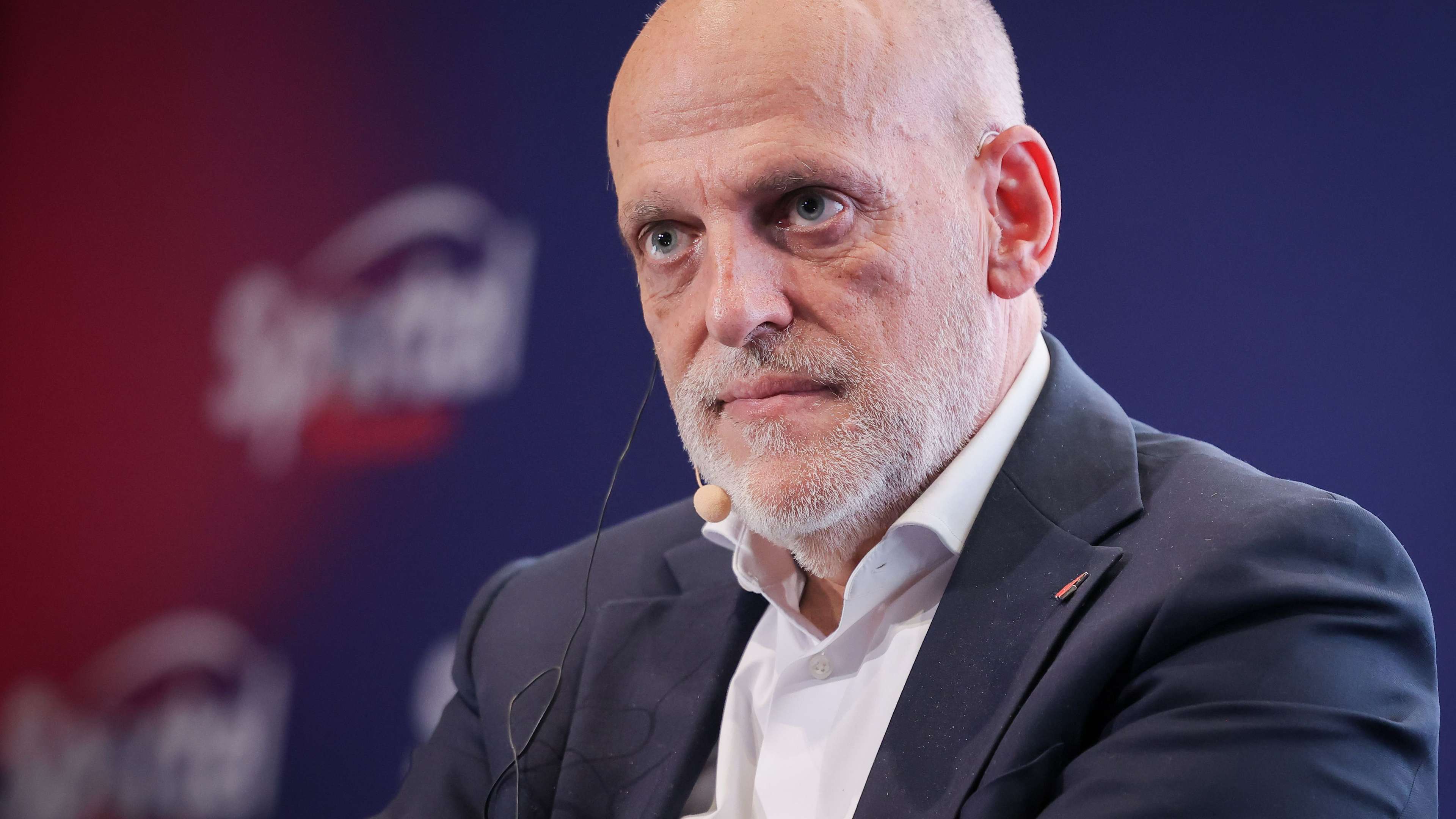
La Liga president Javier Tebas has defended his controversial remarks about Real Madrid’s communications strategy, insisting that he did not compare the club or its officials to Nazis. In an interview with French newspaper L’Équipe, Tebas said his criticism was aimed at a method of communication—not at any individual or institution.
The comments come after a tense week for Spanish football, with reports that Spain’s Higher Sports Council was considering whether to investigate Tebas’s statements. The dispute has added another chapter to the strained relationship between the league chief and Real Madrid, one of Spanish football’s most influential clubs.
Tebas says his criticism targeted a communication strategy
Real Madrid and Tebas have frequently clashed over the governance and public image of Spanish football. His latest remarks sparked backlash after he likened the club’s media approach to Nazi propaganda, a comparison that drew strong criticism and raised questions about whether his language could prompt formal scrutiny.
Speaking to L’Équipe, Tebas sought to clarify what he meant. “I did not describe anyone as a Nazi, I was talking about a communication strategy,” he said, according to Spanish radio station Cadena SER.
The distinction is central to his defence: Tebas says he was criticizing how a message was presented and circulated, rather than accusing Real Madrid or its leadership of sharing Nazi beliefs. Even so, the episode highlights how quickly disputes between football executives can move beyond sporting issues and become battles over reputation, public messaging and institutional responsibility.
For supporters, the row is another reminder that Spanish football’s biggest arguments are not always settled on the pitch. La Liga, Real Madrid and other major clubs have competing interests over the league’s direction, its commercial strategy and how decisions are communicated to fans. The latest exchange is unlikely to resolve those broader tensions.
Ballon d’Or prediction: Tebas backs Rodri and Mbappé
Tebas also discussed the Ballon d’Or race, offering a prediction that stood out because he did not mention Barcelona forward Lamine Yamal, who was among the leading candidates ahead of the ceremony in London.
Instead, the La Liga president praised Manchester City midfielder Rodri and Real Madrid forward Kylian Mbappé. Tebas said an award for Mbappé would be deserved, while adding that he hoped Rodri could repeat his success.
“If Mbappé wins the Ballon d’Or, it would be deserved, but I hope Rodri repeats his achievement,” he said.
His comments reflect two different cases for football’s most prestigious individual honour. Rodri’s appeal rests on his influence in midfield: his ability to control the pace of a match, protect his defence and help his team progress the ball. Mbappé, meanwhile, is recognised for his speed, finishing and capacity to change a game with a decisive attacking moment.
Tebas described Mbappé as “one of the best players in the world” and called him a global star who contributes significantly to his team and to the league. The French forward’s profile is also valuable to La Liga commercially, particularly as the competition seeks to attract international audiences and maintain its place among the world’s leading football leagues.
Leaving Yamal out of his prediction may attract attention, but it should not be treated as a definitive assessment of the teenager’s standing. Ballon d’Or discussions often reflect different views about individual statistics, team achievements, consistency and a player’s impact across a season. Tebas’s preference is one opinion in a debate that depends on how voters weigh those factors.
Strong criticism of FIFA president Gianni Infantino
The interview also turned to FIFA president Gianni Infantino, whom Tebas has opposed for years. The La Liga chief said his view had not changed and argued that recent decisions had reinforced his concerns about the way football’s governing body operates.
“I have opposed him for ten years, and I have not changed my mind,” Tebas said. He criticized what he described as unilateral decision-making, claiming that FIFA does not adequately consult the people and organizations affected by its choices—particularly national federations and domestic leagues.
Among his main concerns are the football calendar, the structure of competitions and the expansion of the Club World Cup. Tebas argues that adding matches and extending major tournaments can place extra pressure on players while disrupting domestic competitions. For leagues, crowded schedules can complicate fixture planning, reduce recovery time and create conflicts between club and international commitments.
Those concerns are part of a wider debate across football. Clubs, leagues, players’ representatives and governing bodies do not always agree on how many matches should be played or who should control the sport’s growing commercial opportunities. Expanding competitions may create new revenue and give more teams access to major events, but critics say those benefits must be balanced against player welfare and the importance of established league competitions.
Tebas also questioned FIFA’s public image, saying it had suffered serious damage over recent years. He added that Infantino’s own reputation was “far from being ideal,” delivering a pointed closing message in an interview already marked by sharp criticism.
A wider power struggle in world football
Tebas’s remarks bring together several of the biggest issues facing modern football: the relationship between leagues and clubs, the influence of global governing bodies, the demands placed on players and the role of public communication in shaping debate. His dispute with Real Madrid is rooted in a specific controversy, but his criticism of FIFA points to a broader disagreement over who should set the sport’s priorities.
For fans following the latest football news, the interview offers insight into how senior figures view those competing interests. Tebas has defended his language, made his Ballon d’Or prediction and renewed his opposition to Infantino’s leadership. Whether those comments ease the Real Madrid dispute or intensify the wider debate remains uncertain, but they underline that football’s most consequential contests can take place far from the stadium.