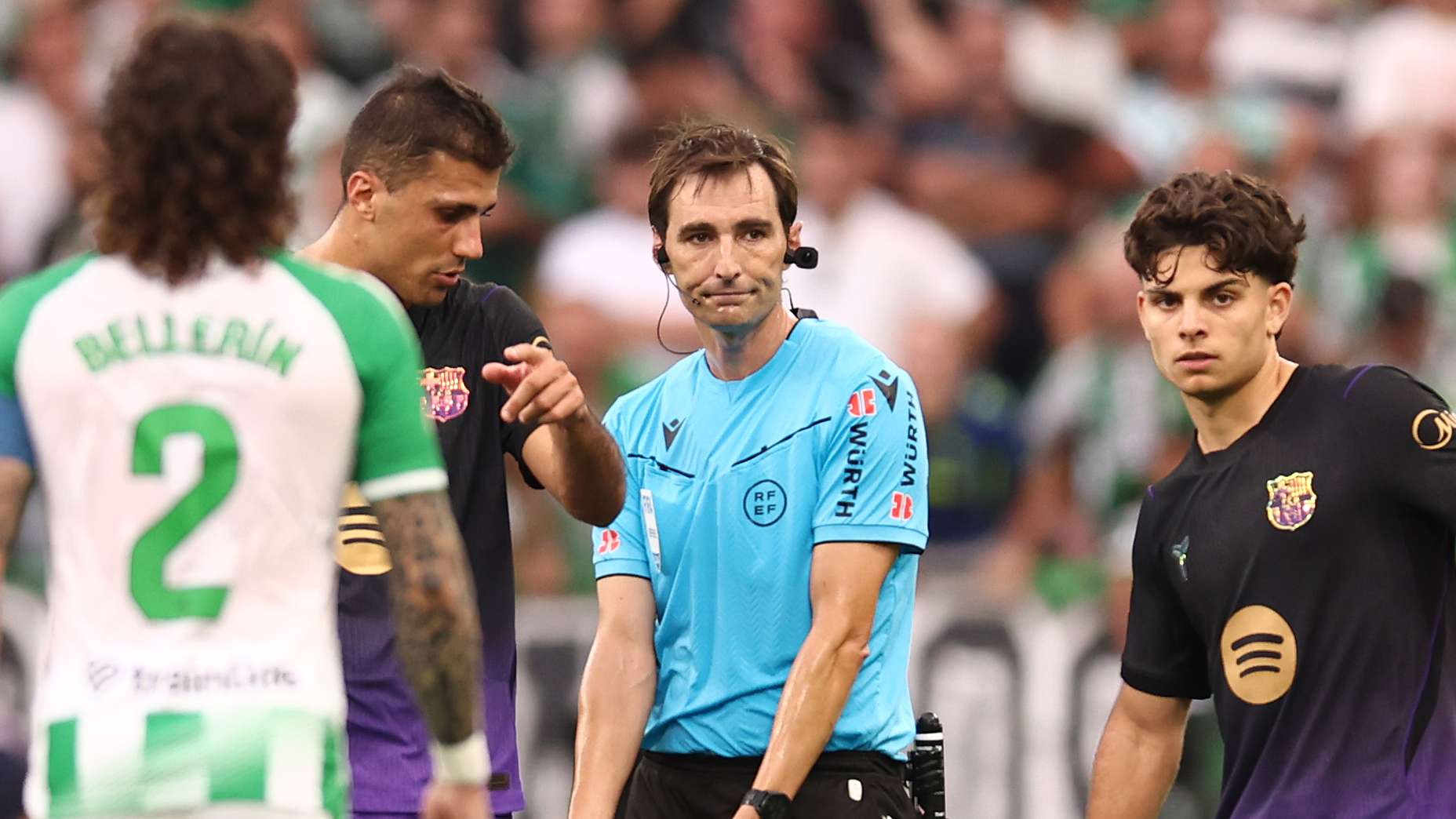

Barcelona’s 5-2 Win Over Real Betis Overshadowed by Refereeing Criticism
Barcelona produced an emphatic 5-2 victory over Real Betis in the ninth round of La Liga, but the scoreline was not the only talking point. Referee Ricardo de Burgos Bengoetxea came under sharp scrutiny after several contentious decisions, with specialist refereeing outlet Archivo VAR awarding him just 3 out of 10.
The low rating reflected a match that featured disputed goals, a video assistant referee (VAR) review and questions about whether some challenges were punished appropriately. While Barcelona claimed a convincing result on the pitch, the officiating debate added another layer to the contest—and may influence discussion around refereeing standards in Spanish football.
VAR Review Raises Questions Over Betis’ Goal
One of the most significant incidents came in the build-up to Giovani Lo Celso’s goal for Betis. Archivo VAR argued that Cucho Hernández deliberately handled the ball at the beginning of the attacking move. In the outlet’s view, the contact should have been penalised even though it occurred before the final phase that led directly to the goal.
The incident was particularly notable because the handball reportedly happened close to the referee, yet De Burgos Bengoetxea still needed VAR to review it. That sequence became a central part of the criticism, with the assessment suggesting that the referee’s on-field view should have been enough to identify the offence.
Handball decisions can be difficult to judge because officials must consider factors such as a player’s arm position, movement and the circumstances of the contact. However, Archivo VAR’s conclusion was clear: Cucho’s action should have resulted in a free kick and the goal should not have stood. The decision therefore became more than a minor technical disagreement—it affected how the match’s scoreline and momentum were interpreted.
Dispute Over Barcelona’s Third Goal
Barcelona’s third goal also drew criticism. The controversy centred on a collision involving Fermín López and Marc Bernal, with questions over whether the play should have been stopped for dangerous conduct before the goal was scored.
Archivo VAR described the incident as difficult to resolve conclusively, acknowledging that it could cause confusion. Nevertheless, the outlet considered the action closer to dangerous play and said the main responsibility for the error rested with the referee on the pitch. Its assessment was more cautious about assigning blame to VAR, distinguishing between the initial decision and the video review process.
That distinction matters in modern football. VAR is designed to correct clear and obvious mistakes in key situations, but it does not replace the referee’s judgement in every close call. When contact is open to interpretation, the video officials may be limited in how far they can intervene. The Barcelona goal controversy therefore highlights the continuing challenge of balancing consistency, the referee’s authority and the technology’s role in a fast-moving match.
Red Card Decision Gets the Right Result
Not every major decision was criticised. De Burgos Bengoetxea sent off Betis player Marc Bernal after an assault on Lamine Yamal, a call Archivo VAR considered correct. However, the outlet credited the assistant referee with helping to identify the incident, suggesting that the decision was not solely the work of the match official in the centre.
The dismissal was an important moment in a game already marked by tension and disputed calls. Red cards can dramatically alter a contest, particularly when a team is trying to recover from a deficit. In this case, the decision was viewed as justified, offering a clear example of the officiating team reaching the correct outcome despite the broader criticism of the referee’s performance.
Llorente’s Challenge: Yellow Card Considered Appropriate
Another flashpoint involved Llorente’s challenge on Jesus. Although the tackle was forceful and prompted debate over whether it merited a red card, Archivo VAR agreed with the decision to show a yellow instead.
The outlet’s reasoning focused on the position of Llorente’s heel, which remained planted on the pitch. Under the interpretation of FIFA guidance cited in the assessment, that detail meant the challenge did not meet the threshold for a straight red card. The incident illustrates how small technical factors can shape disciplinary decisions, even when a tackle looks alarming at full speed.
For supporters, such distinctions can be frustrating, especially when similar challenges appear to receive different punishments across matches. Referees must assess not only the force of a tackle but also its point of contact, the player’s movement and the potential danger to an opponent. The Llorente decision was therefore judged correct by Archivo VAR, despite the intensity of the moment.
A Difficult Afternoon for the Referee
Archivo VAR’s overall verdict was that De Burgos Bengoetxea struggled to maintain control as the first half progressed. Alongside the four headline incidents, the outlet pointed to a wider pattern of decisions it considered affected by infringements or refereeing errors. The result was a performance that, in its assessment, fell well below the expected standard for a high-profile La Liga fixture.
That criticism does not change Barcelona’s victory, but it does shape the post-match conversation. A 5-2 scoreline suggests a decisive performance from the Catalan side, yet disputed calls can still influence the flow of a game, the mood of the players and how fans assess the result. For Betis, the handball decision and the debate around Barcelona’s third goal are likely to remain prominent talking points.
What the Refereeing Debate Means for La Liga
The match underlines why football prediction and match analysis should look beyond the final score. Discipline, VAR interventions and controversial decisions can all affect a team’s momentum and the tactical picture. In this fixture, the sending-off, the disputed goals and the review process created a complicated narrative around an otherwise high-scoring encounter.
For La Liga, the wider issue is consistency. Supporters and clubs want clear explanations of why one incident leads to a review while another does not, and why similar challenges may produce different outcomes. VAR can improve accuracy, but it cannot remove every grey area from football. Transparent communication and consistent application of the rules remain essential if the technology is to strengthen trust in officiating.
Barcelona ultimately left with a 5-2 win, while Betis were left to reflect on a match shaped by both attacking quality and contentious refereeing. Archivo VAR’s 3/10 rating made its view unmistakable: despite getting some key calls right, De Burgos Bengoetxea’s performance was not considered good enough for a game with so many decisive moments.