
Tilak Varma Leads India to Dramatic T20I Win Over New Zealand in Christchurch
India produced a remarkable late comeback in Christchurch, chasing down New Zealand’s 180 for five with one ball to spare and taking a 2-0 lead in the T20I series. Tilak Varma’s unbeaten 51 proved decisive, as he and Nitish Reddy held their nerve after Mitchell Santner had threatened to turn the match into a one-sided New Zealand victory.
The result offered a compelling reminder of cricket’s unpredictable nature in the shortest format. India looked in serious trouble at 115 for six, needing 66 from the final five overs. Yet a powerful finish from Tilak, supported by Reddy, transformed the contest and gave India a four-wicket win. For fans weighing up a match prediction, the game showed how quickly momentum can swing in T20 cricket—even when one side appears firmly in control.
New Zealand Rebuild After Early Wickets
After winning the toss, India captain Shreyas Iyer chose to bowl, with the possibility of dew later in the evening influencing his decision. New Zealand began aggressively: Tim Seifert launched the third ball of the match for six. But the hosts could not sustain that early momentum. Seifert mistimed a shot in the following over and was dismissed, before Bhuvneshwar Kumar removed Daryl Mitchell, who edged a leading delivery to the cover fielder.
Prince Yadav, brought into the XI in place of Mayank Yadav, delivered another significant blow before the Powerplay ended. Finn Allen missed his attempted scoop and was bowled, leaving New Zealand three wickets down inside six overs. The early strikes forced the hosts to rebuild cautiously, and they reached only 66 at the halfway stage after a long stretch without a boundary.
Phillips and Jacobs Lift the Total
Glenn Phillips changed the tempo with a fearless counterattack. He cleared the boundary in consecutive overs and continued to target the Indian bowlers, including a six over long-off against Axar Patel that helped him reach his half-century. At the other end, Bevon Jacobs initially scored at a measured pace, but he shifted gears with two boundaries in an over from Prince Yadav and also passed fifty.
The pair’s partnership gave New Zealand a platform after the early collapse, but India struck back near the end. Arshdeep Singh dismissed Phillips and later removed Jacobs, interrupting the hosts’ push for a bigger total. Jacobs’ dismissal came from a full toss, while Michael Bracewell made an immediate contribution at the finish, hitting a six and a four from his first two deliveries.
New Zealand closed on 180 for five. Phillips top-scored with 70, while Jacobs added 58. Arshdeep finished with two wickets for 33 runs. The total looked competitive, but India’s batting depth meant the hosts still needed early breakthroughs to defend it.
Santner’s Four-Wicket Spell Puts India Under Pressure
Matt Henry set the tone for New Zealand’s defence with a maiden over. India needed a free hit to get moving, and Abhishek Sharma found a couple of early boundaries, but the opening pair struggled to build a stable platform. Jacob Duffy broke through by deceiving Sanju Samson with a back-of-the-hand slower ball.
Vaibhav Sooryavanshi, returning to the XI at No. 3, had a brief opportunity after receiving a reprieve but managed only four from eight deliveries. The pressure intensified when Santner entered the attack. The New Zealand captain removed Abhishek, prompting India to send Axar Patel up the order in an attempt to steady the innings.
Instead, Santner struck twice in the space of three balls. Shreyas Iyer was beaten and bowled, while Axar was caught near the boundary after Allen and Mitchell combined to complete the dismissal. Santner’s control and variation disrupted India’s rhythm, turning a demanding chase into a steep climb. He later claimed the crucial wicket of Naman Dhir, who had been India’s most aggressive batter during the middle overs.
Dhir’s six-hitting offered India a brief route back into the contest. His 31 gave the lower order something to work with, but Santner’s fourth wicket left the visitors needing 46 from the final three overs. With few recognised batters remaining, New Zealand appeared to have the advantage.
Tilak Varma and Nitish Reddy Deliver Under Pressure
Tilak and Reddy responded with composure and calculated aggression. Reddy began the recovery by sending Duffy over the boundary, while Tilak found two important fours to reduce the equation to 29 from 12 balls. The pair understood that a steady accumulation would not be enough; they needed to take risks while keeping the chase within reach.
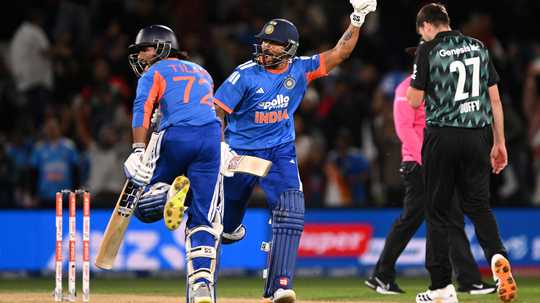
The decisive over came from Nathan Smith. Tilak attacked relentlessly, finding the boundary three times and clearing it once in an 18-run over. That burst dramatically changed the match situation and left India needing 11 from the final six deliveries. Rather than panic, the batters stayed focused. Tilak struck through extra cover and brought up his half-century from the next ball, then Reddy completed the chase with one ball remaining.
Tilak finished unbeaten on 51, anchoring the innings while also supplying the late acceleration India required. Reddy’s contribution was equally valuable in context: his timely six helped shift the pressure back onto New Zealand and gave Tilak a partner willing to attack. Santner ended with an impressive four for 21, but India’s finishing pair ensured his spell did not decide the result.
What the Result Means for the Series
India’s four-wicket victory gives them a commanding 2-0 advantage in the T20I series and leaves New Zealand needing a strong response in the next match. The contest also highlighted several factors likely to shape future cricket predictions: early wickets can create pressure, spin can dominate the middle overs, and a powerful death-overs partnership can overturn even a difficult chase.
New Zealand will take encouragement from Santner’s spell and the recovery led by Phillips and Jacobs, but may look back at the final overs of their innings as an opportunity to add more runs. India, meanwhile, will value the resilience shown after losing wickets in a cluster. Tilak’s calm decision-making, combined with Reddy’s timely hitting, provided the difference in a match that remained uncertain until the final over.
Match Summary
New Zealand: 180/5 in 20 overs — Glenn Phillips 70, Bevon Jacobs 58; Arshdeep Singh 2/33.
India: 181/6 in 19.5 overs — Tilak Varma 51 not out, Naman Dhir 31; Mitchell Santner 4/21.
Result: India won by four wickets and moved 2-0 ahead in the T20I series.