
Vinícius Júnior Faces Possible Clasico Ban as Jorge Valdano Defends Red Card Incident
Real Madrid could be without Vinícius Júnior for the upcoming Clasico after the forward was sent off against Villarreal and later appeared to shove a La Liga employee while leaving the pitch. With the league’s disciplinary process looming, the incidents have raised questions about the length of any suspension—and whether the Brazilian will be available to face Barcelona on 25 October.
Former Real Madrid player and coach Jorge Valdano has spoken out in Vinícius’s defence, arguing that the action that led to his dismissal was impulsive rather than malicious. His comments, reported by Mundo Deportivo, add a prominent voice to a debate that is likely to shape discussion around the punishment and the wider football conversation about red cards, player conduct and disciplinary consistency.
What happened against Villarreal?
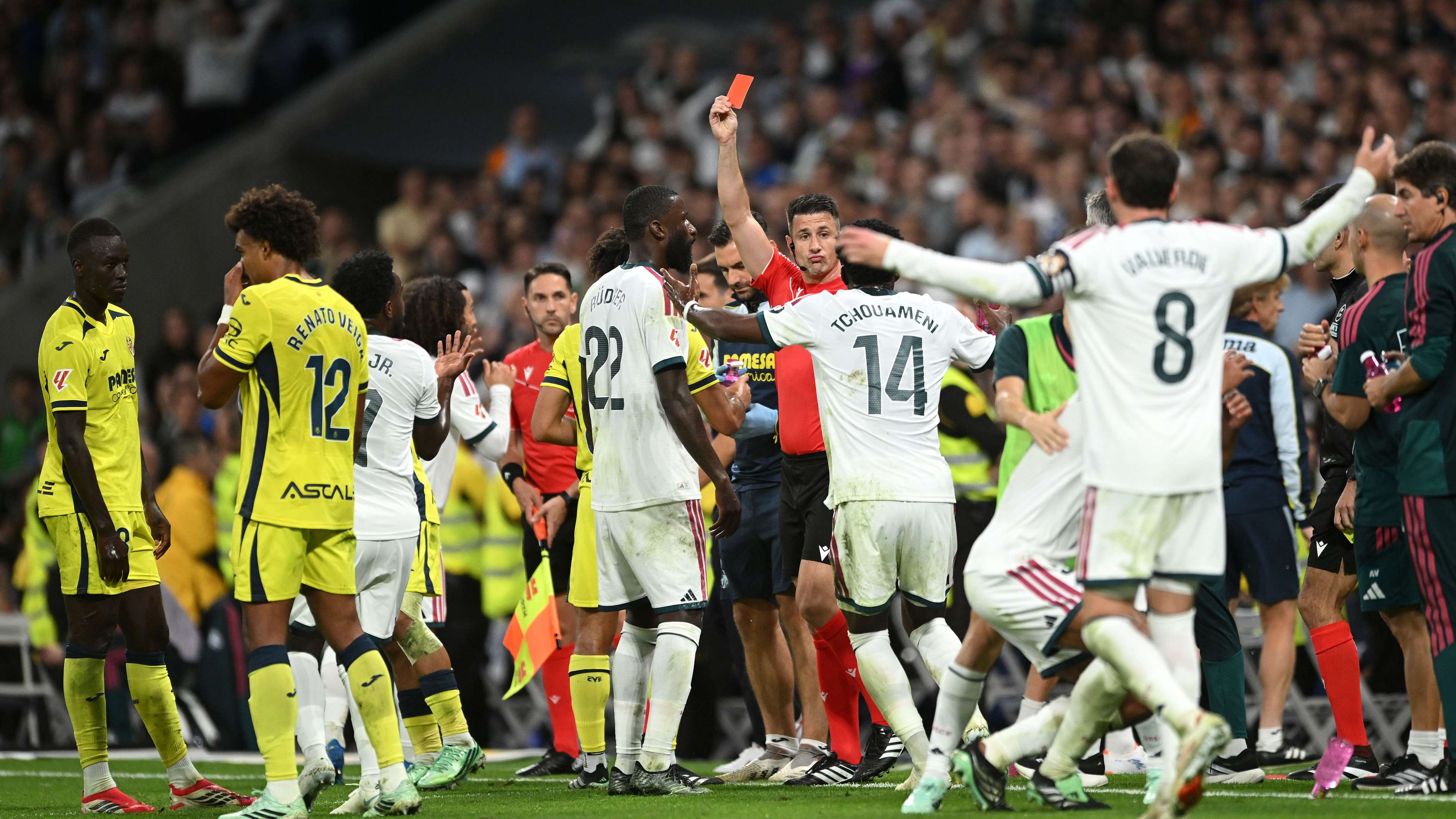
Vinícius was shown a straight red card in the 73rd minute of Real Madrid’s 1-0 victory over Villarreal. The decision followed an altercation involving the Brazilian forward and Villarreal defender Saliba, during which Vinícius pulled his opponent’s hair. The incident quickly became a focus of post-match analysis, particularly because Real Madrid had been protecting a narrow lead in a closely contested game.
Speaking on Movistar after the match, Valdano described the hair-pulling as “a completely spontaneous action.” He contrasted it with conduct he considered more deliberate, saying the episode was different from an act such as spitting. In his view, Vinícius reacted instinctively while trying to break free from an opponent who was closing him down.
Valdano’s explanation did not excuse the action itself. He acknowledged that pulling an opponent’s hair was “the most illegal way possible” to respond to being crowded. But he argued that the nature of the act should be considered when assessing the player’s intentions, adding that he saw “no intent, or nastiness” in what happened.
Why the Clasico is at the centre of the debate
The timing makes the disciplinary decision especially significant. Vinícius could reportedly face a ban of at least two matches, a suspension that would put his participation in the Clasico against Barcelona on 25 October at risk. For Real Madrid, losing one of their most influential attackers for a fixture of that scale would be a major sporting setback.
Vinícius is central to Madrid’s attacking threat, using his pace, close control and ability to take on defenders to stretch opposition back lines. His presence can force teams to commit extra players to the flank, creating space for teammates elsewhere. A Clasico without him would therefore affect not only Madrid’s finishing options but also the way the team builds attacks and seeks to unsettle Barcelona’s defence.
Still, the importance of the match does not determine the punishment. Disciplinary authorities will assess the available reports and evidence, including the referee’s account of the dismissal. The distinction between an impulsive reaction and deliberate violent conduct may be relevant, but the final decision will depend on the applicable rules and how the incident is officially classified.
The tunnel incident could complicate matters
The hair-pulling episode is not the only concern for Madrid. Vinícius is also reported to have shoved a La Liga employee as he headed down the tunnel after being sent off. If that interaction is confirmed and included in the disciplinary review, it could influence the severity of the sanction.
Post-dismissal conduct often attracts close scrutiny because players are expected to leave the field and surrounding areas without further confrontation. The circumstances matter: investigators may consider what happened, whether there was physical contact, and how the incident is described by those involved. Until those details are established, it remains unclear whether the reported shove will lead to an additional charge or a longer suspension.
That uncertainty creates a difficult period for Real Madrid. The club must prepare for upcoming fixtures without knowing whether its leading forward will be available for the biggest domestic match on the calendar. A final ruling could also affect how the team manages its attacking rotation in the games before the Clasico.
Valdano’s defence and the wider football discussion
Valdano’s comments are likely to resonate because they separate the legality of an action from the player’s perceived intent. His argument is that Vinícius’s response was unacceptable but spontaneous, rather than a calculated attempt to injure or intimidate an opponent. That distinction often sits at the heart of debates over football discipline, where the same physical action can be interpreted differently depending on its context.
There is also a broader question about how officials and disciplinary bodies handle emotionally charged exchanges. Players regularly compete in tight spaces, with close marking and physical pressure increasing the chance of flashpoints. That context can help explain a reaction, but it does not remove a player’s responsibility to control it—particularly when the consequences include a red card and a potential suspension.
For supporters, the case is also a reminder that a match can turn on a brief moment. Real Madrid left Villarreal with a 1-0 win, but the late dismissal has shifted attention from the result to the availability of one of the club’s most important players. The final ruling will determine whether the incident remains a post-match talking point or becomes a decisive factor in Clasico preparations.
Clasico prediction depends on the final ruling
Any early football prediction for Real Madrid versus Barcelona must account for uncertainty over Vinícius’s status. If he is cleared to play, Madrid would retain a major source of speed and one-on-one threat. If he is suspended, the coaching staff would need to find another way to stretch Barcelona’s defence, potentially changing the team’s shape and attacking balance.
For now, Valdano’s defence has added nuance to the debate, but it cannot settle the case. Real Madrid will be waiting for the disciplinary decision, while supporters on both sides watch to see whether Vinícius is available for the Clasico. Until the ruling is announced, the red card—and the reported tunnel incident—remain central to the build-up to one of football’s most anticipated fixtures.