
Marten de Roon Makes Roma European History in Dramatic Champions League Night
Marten de Roon’s goal against Real Madrid was more than a brief spark in a chaotic night at the Stadio Olimpico. The Netherlands midfielder also claimed a place in Roma’s European record books, becoming the oldest non-Italian player to score for the club in the Champions League or European Cup.
De Roon was 35 years and 199 days old when he found the net, according to statistics provider Opta. His strike surpassed the previous mark held by Gabriel Batistuta, who was 33 years and 312 days old when he scored against Ajax in 2002. More than 23 years after Batistuta set the benchmark, De Roon’s goal gave Roma supporters a fresh milestone to celebrate.
A deflected strike ignites the Stadio Olimpico
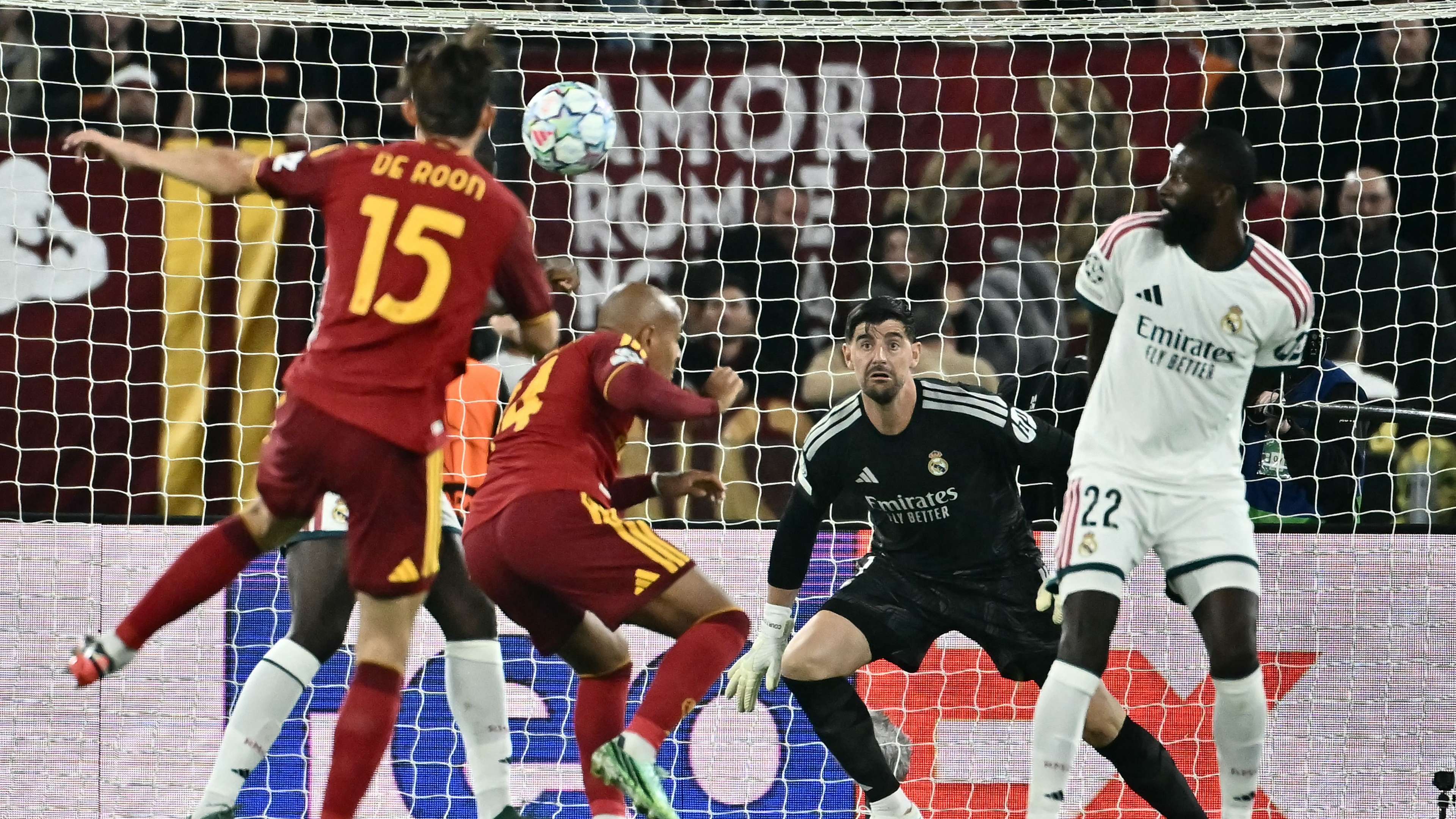
Roma began with intensity under Gian Piero Gasperini, pressing forward and looking to unsettle the Spanish visitors. Their positive start was rewarded in the 21st minute, when De Roon collected the ball near the edge of the penalty area and struck toward goal.
The effort took a decisive deflection off a teammate, changing direction and leaving Real Madrid goalkeeper Thibaut Courtois with little chance to react. The ball flew into the net, sending the Olimpico crowd into celebration and putting Roma ahead in a match that already carried the feel of a European occasion.
Although the deflection shaped the finish, De Roon’s willingness to shoot was central to the moment. From distance, a midfielder’s attempt can be a way to test the goalkeeper, create a rebound or force a defensive mistake. On this occasion, it produced both a goal and a historic entry in Roma’s European record book.
Mbappé responds almost immediately
Roma’s lead lasted only two minutes. Real Madrid capitalised on an error by Mario Hermoso, with Kylian Mbappé collecting the opportunity and driving a shot into the net from the edge of the area. The finish echoed Roma’s opener: a quick strike from outside the box that gave the goalkeeper little time to intervene.
The rapid equaliser changed the mood of the contest almost as soon as the home fans had begun celebrating. Roma had shown they could threaten one of Europe’s most formidable clubs, but Madrid’s immediate response was a reminder of the danger posed by even a brief lapse in concentration.
For Roma, the sequence offered a snapshot of the challenge against elite European opposition. A strong spell and a well-timed attacking effort can create momentum, but maintaining that advantage requires discipline across the pitch. Madrid’s ability to punish an individual mistake underscored why matches at this level can turn in a matter of moments.
What the record means for De Roon and Roma
De Roon’s achievement stands out because Roma’s European history includes generations of prominent international players. To move ahead of a record associated with Batistuta—a celebrated forward whose name remains closely linked with the club—makes the midfielder’s contribution especially memorable.
The milestone also reflects De Roon’s longevity. Reaching the Champions League scoring column at 35 is a notable accomplishment in a competition where speed, fitness and consistency are tested against some of the strongest teams in football. His goal demonstrated that experienced players can still shape major European nights, whether through tactical awareness, composure or the confidence to take on a shot.
For Roma, the strike provided an early reward for an energetic start under Gasperini. The coach’s side looked prepared to attack rather than simply absorb pressure, and De Roon’s willingness to join the move from midfield added another dimension to the team’s approach. That kind of contribution can be valuable when opponents focus their defensive attention on the forwards.
Match prediction and the wider European picture
Any match prediction after such an eventful opening has to account for the contrasting strengths on display. Roma showed that they could create danger in front of their home crowd, while Real Madrid demonstrated how quickly they can turn a defensive opportunity into an equaliser. The opening exchanges pointed to a contest in which concentration, transition defending and finishing could prove decisive.
Roma’s best route forward was likely to involve keeping the intensity of their opening spell while reducing the errors that allow Madrid to attack space. De Roon’s goal offered evidence that Roma could threaten from midfield, but the response from Mbappé highlighted the need for careful protection around the edge of the area. Against a team with Madrid’s attacking quality, even a small gap can become a scoring chance.
For neutral viewers, the quick exchange of goals set up an engaging European contest. Roma had the atmosphere and an early burst of momentum; Madrid brought experience and the ability to respond under pressure. Rather than settling into a cautious rhythm, the match immediately became a test of whether Roma could sustain their attacking ambition and whether Madrid could take advantage of further openings.
A memorable moment, whatever followed
The score was level again by the 23rd minute, but De Roon’s place in Roma’s European story had already been secured. His strike ended a record that had stood since Batistuta’s goal against Ajax in 2002 and gave the home crowd a moment that will be remembered beyond the match itself.
On a night shaped by a deflection, a swift Madrid response and the intensity of Champions League football, De Roon’s achievement added a lasting historical note. Roma still had work to do after Mbappé’s equaliser, but their midfielder had already shown that a single moment can connect a current European campaign with the club’s past.