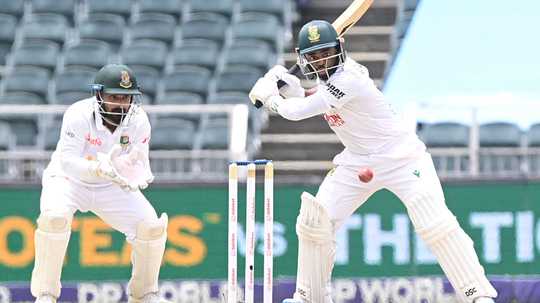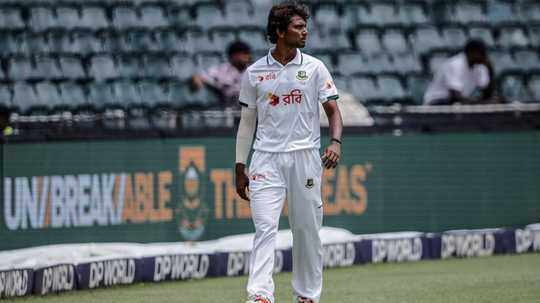

Bangladesh Face Hasan Mahmud Fitness Concern Ahead of Second Test Against South Africa
Bangladesh captain Najmul Hossain Shanto says the team is still waiting to learn whether fast bowler Hasan Mahmud will be fit for the second Test against South Africa. With the next match scheduled in Centurion and little time available for recovery, Hasan’s recurring tennis elbow has become a major concern for Bangladesh’s plans.
Hasan made a strong contribution in the opening Test, taking four wickets in South Africa’s first innings. However, the elbow problem resurfaced during the Johannesburg contest, leaving his availability uncertain. His absence would deprive Bangladesh of a bowler who can offer pace and early breakthroughs, although the team will not make a final decision until its medical staff have assessed him.
“Still, I’m not sure,” Najmul said on Thursday. “The physio and the trainer will look after him, and if he is fit, he will play. But we are still not sure about him and how he feels in his body.”
Fitness Assessment Could Shape Bangladesh’s Bowling Plans
Hasan’s condition is particularly important because Bangladesh are balancing the demands of a demanding Test schedule with the need to field a varied attack. Fast bowlers can be vulnerable to recurring injuries when matches come in quick succession, and tennis elbow can affect a player’s ability to bowl comfortably and consistently. The medical team’s assessment will therefore be central to any selection decision.
If Hasan is unavailable, Bangladesh may need to adjust both their personnel and their bowling roles. A replacement would not necessarily be expected to reproduce Hasan’s performance, but would need to help maintain pressure across long spells and provide support to the other seamers. The pitch and the condition of the ball will also influence how the captain deploys his attack.
For supporters following the series, Hasan’s status is one of the key developments to watch ahead of the second Test. Any cricket prediction about Bangladesh’s chances should account for the uncertainty: a fit Hasan would strengthen the pace unit, while his absence could place greater responsibility on the remaining bowlers.
Why Bangladesh Selected Ebadot Hossain
Najmul also explained why Bangladesh chose Ebadot Hossain ahead of Shoriful Islam for the opening Test. The decision, he said, was based on the balance of the bowling attack and the need for a seamer capable of operating with the older ball. Bangladesh already had several bowlers more naturally suited to using the new ball, so the selectors wanted a different option for the middle stages of an innings.
“If you look at our bowling combination, Taskin, Hasan, these guys are all new-ball bowlers, and Shoriful also most likely likes to bowl with the new ball,” Najmul said. “So we needed someone who can bowl in the middle overs, someone like Ebadot who bowled a bit faster. That’s why we picked Ebadot.”
The captain acknowledged that Ebadot’s impact in the match may not have matched the team’s expectations, including because he bowled less than planned. Even so, Najmul defended the selection as a considered attempt to build a complementary attack rather than simply choose the most familiar combination.
Workload Management Remains a Challenge
Bangladesh’s choices are also shaped by the workload placed on a relatively small group of Test fast bowlers. Najmul said the team had played four consecutive Tests and could not rely on the same players to feature in every match without considering recovery. Taskin Ahmed, for example, had already appeared in several recent Tests, while Shoriful had also been used during the preceding series.
“The five or six bowlers we have, we actually have to rotate them,” Najmul explained. “Many of our bowlers are not in a position to play two or three Test matches back-to-back. We don’t have many backup bowlers like that either.”
That limited depth makes selection a balancing act. Bangladesh must weigh a bowler’s current form against fatigue, fitness and the demands of the conditions. Rotation can sometimes mean leaving out a player who appears suited to a particular match, but it may help preserve the attack over a packed schedule. Najmul said the team wanted a bowler who could offer extra threat with the old ball, a role he believed Ebadot could fulfil.
Fielding Errors Cost Bangladesh After a Strong Batting Effort
Bangladesh’s opening-Test defeat was especially frustrating because the team had scored 400 runs. Najmul said the side’s errors in the field and with the ball helped South Africa take control, pointing to dropped catches and an excessive number of no-balls as avoidable problems.
“We made too many mistakes. We bowled too many no-balls and dropped catches. That’s probably why we lost the match even after scoring 400,” he said.
Najmul highlighted an early missed chance to dismiss Ryan Rickelton, noting that taking the catch could have changed the course of South Africa’s innings. Against a leading Test side, missed opportunities can quickly become costly: a batter who survives an early chance may settle in, build a partnership and force the opposition to spend longer in the field.
The captain’s assessment was straightforward: Bangladesh need to reduce basic errors if they are to compete more consistently. No-balls not only give the batting side extra deliveries but can also disrupt a bowler’s rhythm, while missed catches extend innings and increase pressure on the attack. Improving those details could matter as much as any change in the playing XI.
Najmul Backs Mushfiqur and Mominul to Respond
Despite the team’s disappointing result, Najmul expressed confidence in experienced batters Mushfiqur Rahim and Mominul Haque. Both had modest returns in the first Test, but the captain believes their experience and mental strength can help Bangladesh in Centurion.
Najmul pointed to Mushfiqur’s broader contribution during the current cycle, including an average close to 44, and said his value extends beyond runs. His experience in the dressing room and on the field remains important to a team seeking to recover from a difficult defeat.
“I have absolutely no doubt about Mushfiq bhai, and I know he will make an even better comeback in the next match,” Najmul said.
Mominul, meanwhile, has found batting away from home challenging, but Najmul believes the former captain’s experience and resilience can still benefit the side. A substantial innings from either senior batter would help Bangladesh build a stronger platform and ease the pressure on the middle order.
What Bangladesh Must Improve in Centurion
Bangladesh’s route back into the series will depend on more than Hasan Mahmud’s fitness. The team will need to take its chances, limit no-balls, manage its fast bowlers carefully and convert promising batting starts into sustained partnerships. South Africa will remain a formidable opponent, but Najmul’s comments suggest Bangladesh are focused on correcting controllable mistakes rather than relying on selection changes alone.
The final team combination will become clearer after Hasan’s fitness assessment and the management’s review of workload. Until then, the second Test carries several questions for Bangladesh: whether their leading seamer can recover, whether Ebadot’s role will continue, and whether the senior batters can deliver. Those factors will shape the contest—and any informed cricket prediction—as the teams prepare for the next match.