
Ali Al-Bulaihi’s Red Card Puts Saudi Pro League Record Back in Focus
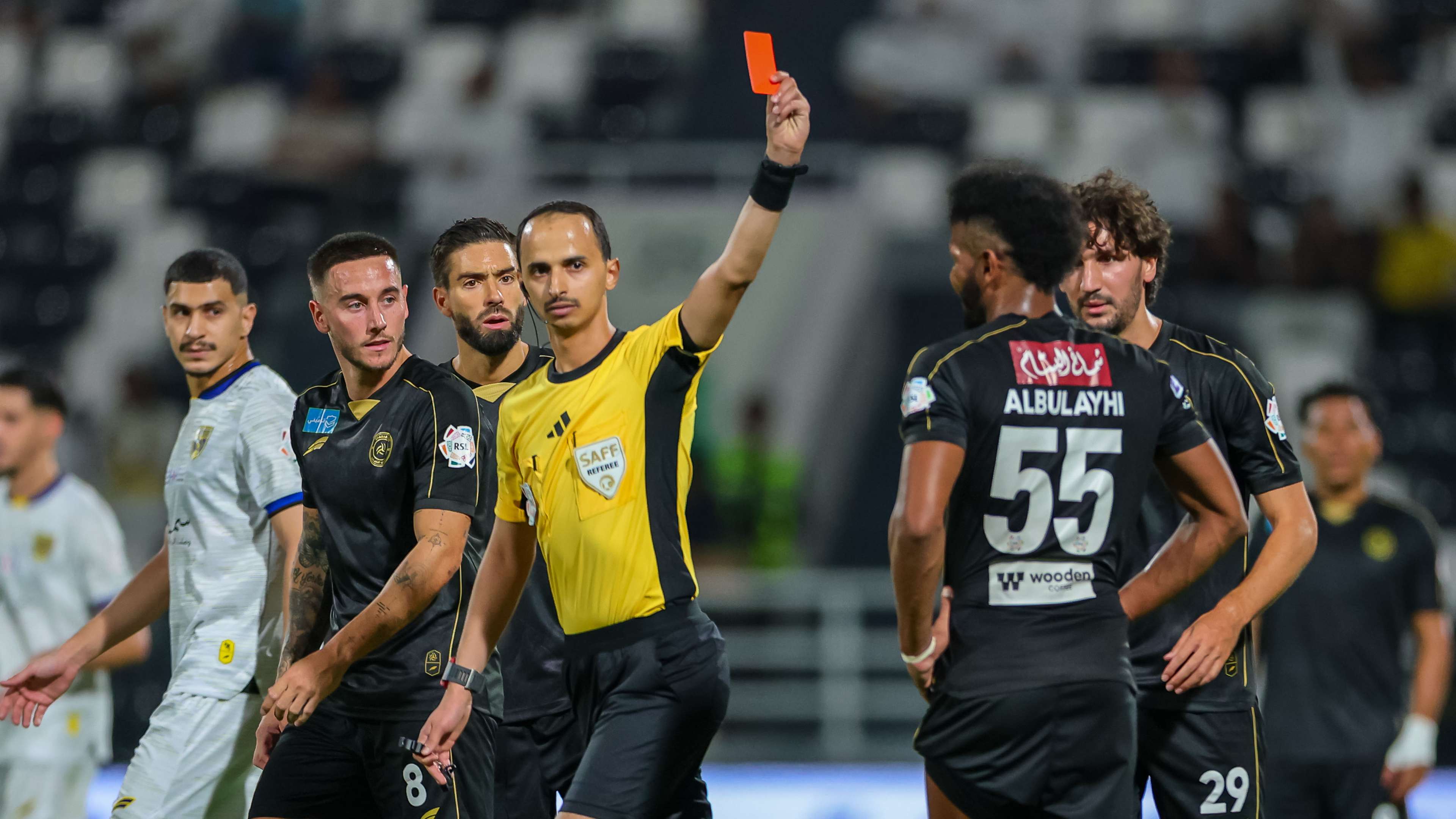
Al-Shabab were forced to adjust their plans early in their Saudi Pro League meeting with Al-Taawoun after defender Ali Al-Bulaihi was sent off in the 33rd minute. The dismissal left his team with ten players for the remainder of the match and renewed attention on the Saudi international’s growing record of red cards in the competition.
The incident came as Al-Taawoun forward Mohammed Al-Kuwaykibi advanced towards goal. Al-Bulaihi brought him down, and the referee reviewed the challenge using the video assistant referee system, or VAR. After checking the footage, the official ruled that the defender had denied Al-Kuwaykibi a clear goalscoring opportunity and showed him a straight red card.
For Al-Shabab, the timing was particularly difficult. Losing a defender before half-time can force a team to change its shape, sacrifice an attacking option and devote more players to protecting its own goal. The dismissal also gave Al-Taawoun an opportunity to exploit the numerical advantage, making the contest a test of Al-Shabab’s discipline and defensive organisation as much as its footballing quality.
Al-Bulaihi joins a high-profile group in the red-card rankings
Statistics from football data specialists Opta place Al-Bulaihi on five dismissals in the Saudi Pro League since the 2009–10 season. That total is tied for the second-highest in the competition during that period, alongside eight other players. The figure puts the defender among the league’s most frequently sent-off players and adds an unwelcome distinction to his record.
Only Mohammed Al-Khabrani is ahead of him in the ranking. Al-Khabrani has received seven red cards since the 2009–10 campaign, while Al-Bulaihi is part of a group of nine players with five dismissals apiece. The statistic does not, by itself, explain the circumstances behind each card, but it highlights how often Al-Bulaihi’s career has included moments that have resulted in an early exit from the pitch.
Red-card figures can be influenced by a player’s position and role. Defenders are often required to make urgent decisions when an opponent breaks through, and a mistimed challenge can carry a serious cost. In this case, the referee’s decision centred on the denial of a clear chance, rather than simply the force of the contact. VAR gave the officials an opportunity to review the play before confirming the punishment.
A fixture with a recent history of dismissals
Al-Bulaihi’s latest red card also adds to an unusual pattern in recent meetings between Al-Shabab and Al-Taawoun. The clubs’ previous four encounters have produced four dismissals, involving Al-Bulaihi, Abdullah Matouq, Mohammed Al-Shuwairekh and Brazilian defender Andre Girotto.
That sequence makes discipline a notable theme whenever the sides meet. It does not necessarily mean that future games will follow the same script, but repeated dismissals can shape the way teams approach a fixture. Coaches may urge players to avoid risky challenges, while attackers could look to draw defenders into difficult one-on-one situations. In a close match, one decision can quickly alter the balance of possession, territory and momentum.
For Al-Shabab, the immediate challenge was to respond to the loss of a key defender without allowing the match to become disorganised. Teams playing with ten men commonly narrow their defensive shape and reduce the space between the lines, then look for opportunities to counterattack. That approach can help limit danger, but it also demands concentration and coordination from every player on the pitch.
What the dismissal means for Al-Shabab
Al-Bulaihi’s absence left Al-Shabab with less room for error at the back. When a centre-back is dismissed, a manager may need to bring on another defender, reposition a midfielder or ask the remaining back line to take on additional responsibilities. Each option involves a trade-off: strengthening the defence can reduce attacking threat, while keeping forward players on the pitch may leave the team exposed.
The incident also places renewed focus on Al-Bulaihi’s decision-making in high-pressure moments. Defenders must judge not only whether they can stop an opponent but also what the consequences of a failed challenge might be. When a forward is moving directly towards goal, the risk of a red card can become especially high. The referee’s VAR review confirmed that the challenge met the threshold for a dismissal in this instance.
For supporters following the Saudi Pro League, the episode offers a reminder of how quickly a match can change. A game that begins with both teams at full strength can become a tactical contest shaped by one challenge, one review and one decision. It also gives Al-Shabab a clear area to consider as the season continues: maintaining defensive aggression while avoiding actions that leave the side short-handed.
Looking ahead: fixtures, form and prediction
Al-Shabab’s next scheduled fixtures include an AFC Champions League Two match on 15 October 2026, followed by a Saudi Pro League meeting on 17 October 2026. Those games will provide an opportunity for the squad to move on from the Al-Taawoun encounter, although Al-Bulaihi’s availability will depend on the disciplinary process and any suspension arising from the red card.
Any football prediction for Al-Shabab’s upcoming matches should account for more than a single result or statistic. Team selection, player availability, recent form and the ability to stay disciplined can all influence the outcome. Al-Bulaihi’s dismissal is a reminder that defensive organisation matters, but so does composure: avoiding unnecessary risks may prove just as important as making decisive tackles.
Ultimately, the latest incident has two lasting talking points. It adds another entry to Al-Bulaihi’s record in the Saudi Pro League, placing him level with a sizeable group of players on five dismissals, and it extends a striking run of red cards in recent Al-Shabab–Al-Taawoun meetings. For the defender and his club, the focus now shifts to learning from the moment, managing the consequences and ensuring that future matches are decided by football rather than another costly dismissal.