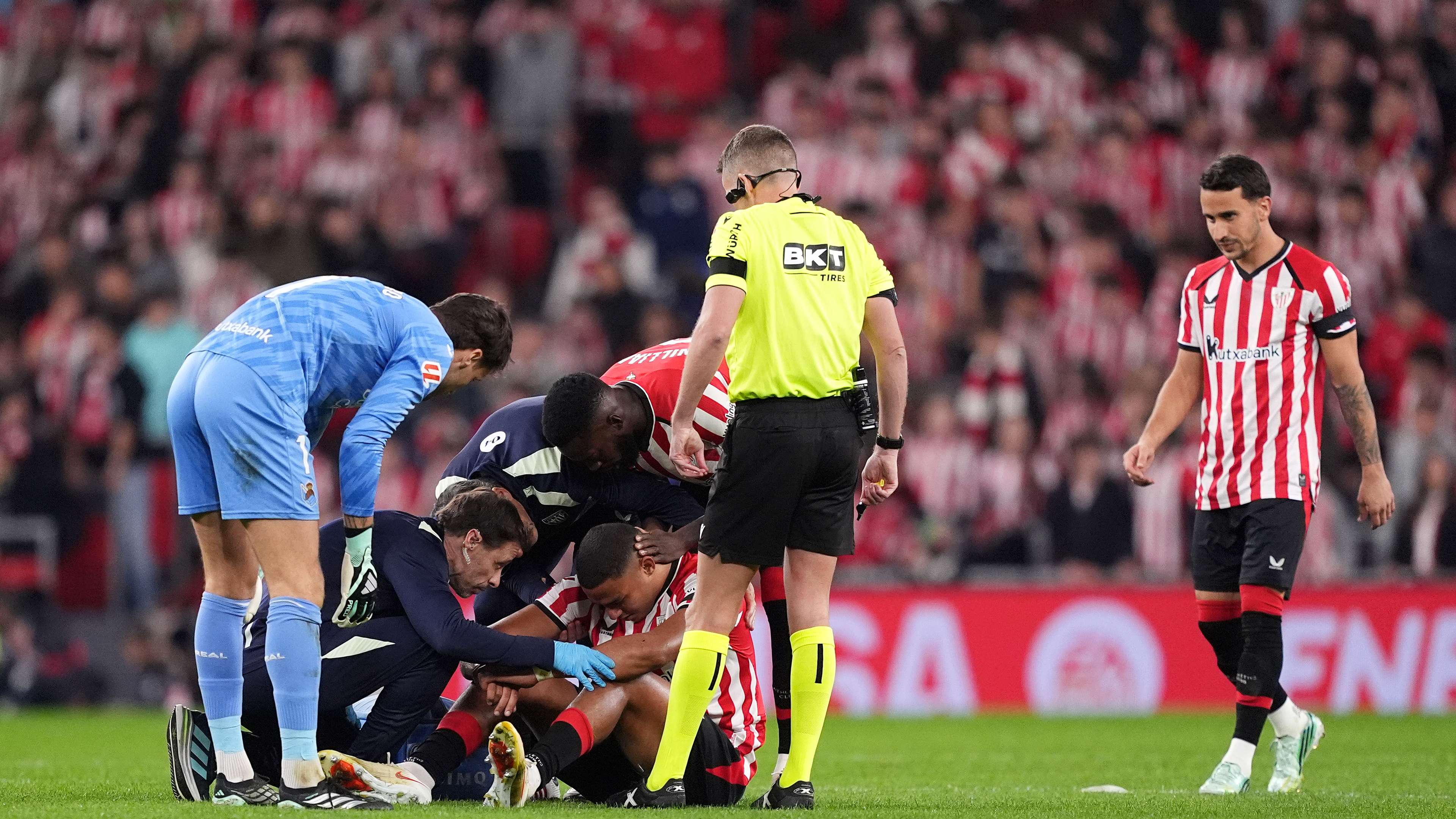

Connected-Ball Synchronisation Error Puts Athletic Bilbao Penalty Decision Under Scrutiny
A technical timing discrepancy has cast fresh doubt on the penalty that helped Athletic Bilbao score their second goal against Real Sociedad at San Mamés. The Royal Spanish Football Federation’s Technical Refereeing Committee has requested and reviewed an investigation from Kinexon, the company responsible for the match’s connected-ball technology, after data from the system appeared to conflict with the video review.
The incident took place during the first half of the Basque derby, part of the Spanish league’s 11th round. The on-field referee awarded Athletic a penalty after judging that a Real Sociedad defender had fouled an Athletic forward. But the review-room decision became controversial because officials believed the connected-ball signal showed the Athletic player making the final touch before the apparent contact.
Kinexon’s analysis now indicates that a slight mismatch between the ball data and the video clip may have affected how the sequence was interpreted. Once the two sources were correctly aligned, the data was consistent with the images and suggested that the Real Sociedad player reached the ball last. That finding raises questions about whether the penalty decision was correct, while also highlighting the importance of understanding what information officials could see at the time.
What Happened During the Video Review?
Before kick-off, the video assistant referee and the video technology operator completed the synchronisation process required by the protocol. No problem was detected. The official was experienced in using connected-ball systems, having worked with the technology at the World Cup and received specialist training. Mediapro also carried out random checks during the match to test the integrity of the synchronisation.
When the penalty incident was reviewed, staff in the video technology room examined the available footage alongside the connected-ball signal. In the initial display, a prominent data peak appeared to match a touch by the Athletic player. No later peak appeared at the moment when the Real Sociedad defender seemed to make contact with the ball. Based on that presentation, the review team concluded that the Athletic player had touched it and the defender had not.
The picture became more complicated when the technical data was later transferred to the television broadcast. The Athletic player’s apparent touch lined up with the final peak shown in the original data. However, two earlier peaks were also visible, and their relationship to the footage was unclear. The federation’s Technical Refereeing Committee asked Kinexon to investigate what those peaks represented and whether the signal had been correctly aligned with the video.
Kinexon Identifies a Difference of Up to Two Frames
According to the committee’s account of Kinexon’s findings, the most likely cause was a small synchronisation difference between the connected ball’s signal and the video clip used in the review. The gap was estimated at one to two frames—around 20 to 40 milliseconds when working with footage recorded at 50 frames per second.
That may sound negligible, but in a fast-moving football sequence, a fraction of a second can change how a touch appears to match a data signal. In the original presentation, the signal peaks appeared slightly before the corresponding contacts in the video. This could have led reviewers to associate a peak with the wrong player. Because another peak did not appear at the apparent moment of the defender’s touch, the sequence seemed to support the conclusion that he had not reached the ball.
After Kinexon corrected the timing difference and re-synchronised the signal with the footage, the data aligned more closely with the images—not only during the disputed touch, but also in the moments before and after it. The strongest peak then corresponded to the Real Sociedad player reaching the ball. On that basis, the report concluded that the defender was the last player to touch it.
Does the Finding Mean the Penalty Was Wrong?
The updated analysis suggests the original interpretation of the final touch may have been mistaken. If the Real Sociedad player touched the ball last, the sequence could affect how the incident should have been judged and whether the penalty was warranted. However, the committee has cautioned against assessing the officials’ actions solely with the benefit of information that became clear only after the technical data was re-synchronised.
Its statement stressed that the video assistant referee’s decision must be considered in light of the information available during the review. At that point, the system’s display showed no evidence sufficient to overturn the referee’s on-field decision. The data appeared to support the view that the Athletic player had made the last touch, so the review-room call was considered correct based on what officials could see at the time.
This distinction matters in any discussion of a controversial football decision. There is a difference between asking whether the final outcome was right and assessing whether officials followed the correct process using the evidence available to them. The later report provides a clearer explanation of the sequence, but it does not mean the video officials knowingly ignored evidence pointing the other way.
How Connected-Ball Technology Works
Kinexon’s connected ball contains a sensor that records highly precise timing information. In a video review using broadcast footage, the ball signal must be aligned with the relevant video clip. That alignment is completed manually before the match through a controlled process that includes bouncing the ball in a specific manner.
This differs from the synchronisation used in semi-automated offside technology. That system continuously aligns the connected ball with dedicated tracking cameras through a precise timing protocol, rather than relying on manual alignment with broadcast footage. The distinction helps explain why a ball sensor can operate correctly while a separate timing mismatch still affects the way its data is displayed alongside video.
The committee said the connected-ball technology itself functioned throughout the Athletic Bilbao–Real Sociedad match. The fault was the timing difference between the ball signal and the clip used by the video technology team. In other words, the issue was not that the sensor stopped working, but that its information and the images were briefly out of step.
What the Incident Means for Future VAR Reviews
The case is likely to renew debate about how technological evidence is presented during high-pressure football reviews. Connected-ball data can offer valuable information, but it must be interpreted alongside video and with careful attention to timing. Even a small discrepancy can create uncertainty when officials are making a decision in seconds, particularly in a derby where a penalty can have a major influence on the match.
The Technical Refereeing Committee said it will continue working with the technology companies and specialists involved to improve procedures, strengthen synchronisation checks and reduce the risk of similar incidents. The aim is to make technological tools more reliable and ensure they support referees without introducing new sources of confusion.
For supporters assessing the penalty, the Kinexon report provides a more complete account of why the original review reached its conclusion—and why the later analysis pointed to a different final touch. Any prediction about how such incidents will be handled in future should remain cautious: technology can sharpen refereeing decisions, but only when the data, footage and timing are accurately aligned.