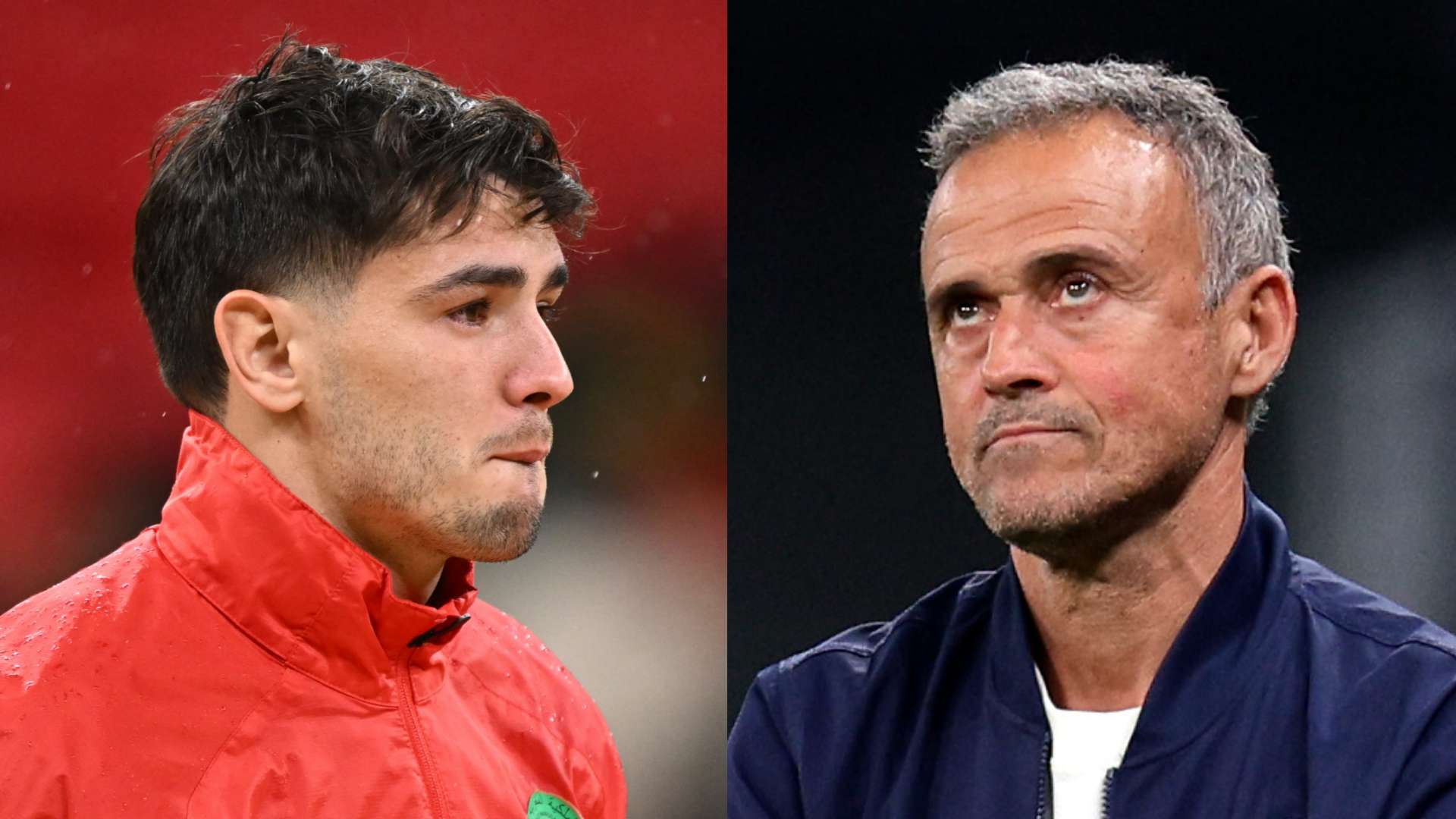

Paris Saint-Germain manager, Luis Enrique, has come out in support of Real Madrid’s Brahim Diaz after his high-profile penalty miss during the Africa Cup of Nations final. The incident, which saw Diaz attempt a Panenka in stoppage time, has sparked debate and criticism from football fans and experts alike. Enrique, however, has defended the young forward, emphasizing that Diaz is not to be judged solely based on this one moment.
According to Enrique, Diaz should not be viewed as an “assassin” or a “bad person” for his decision to take the penalty in such a daring manner. The manager’s comments come in the wake of significant backlash against Diaz, with many questioning his judgment and composure in such a crucial moment. Despite the outcome, Enrique believes that Diaz’s intentions were not malicious and that he should not be vilified for taking a risk.
Enrique’s words of support have been echoed by former Real Madrid captain, Sergio Ramos, who has offered words of encouragement to Diaz following the devastating loss to Senegal. Ramos, who played alongside Diaz during his time at the Spanish club, has urged the young star to remain strong and not let this setback define his career. The veteran defender has emphasized the importance of resilience and mental fortitude in the face of adversity, highlighting Diaz’s potential for growth and success in the future.
The incident has reignited discussions around the art of penalty taking in football and the risks involved in attempting a Panenka, a technique famously named after Czech player Antonin Panenka. While successful Panenka penalties are celebrated for their audacity and skill, they also come with a high level of risk, as seen in Diaz’s case. The young forward’s decision to attempt the Panenka in such a crucial moment has divided opinions among fans and experts, with some praising his boldness and others criticizing his lack of experience and judgment.
Moving forward, Diaz will need to demonstrate resilience and determination to bounce back from this setback. Despite the disappointment of the missed penalty, Diaz’s performance throughout the tournament has been commendable, showcasing his potential as a rising star in the world of football. As he continues to develop and hone his skills, Diaz will have the opportunity to learn from this experience and emerge stronger and more confident in future challenges.
In conclusion, the support shown by Luis Enrique and Sergio Ramos highlights the importance of unity and encouragement within the football community. While Diaz’s penalty miss may have been a moment of disappointment, it should not overshadow his talent and potential as a player. As he navigates the highs and lows of professional football, Diaz will have the opportunity to prove his critics wrong and make a lasting impact on the sport.
Analysis of Penalty Taking in Football
Penalty kicks are one of the most intense and decisive moments in a football match. The pressure on the taker is immense, as they have the opportunity to score a crucial goal or face the consequences of a miss. The decision to attempt a Panenka, a cheeky technique that involves a soft chip over the goalkeeper, adds an extra layer of risk and reward to the situation.
Players like Brahim Diaz who choose to execute a Panenka are often lauded for their confidence and skill. Successful Panenkas can be a spectacle to behold, leaving goalkeepers rooted to the spot as the ball gently glides into the net. However, the margin for error is slim, and any miscalculation can result in embarrassment and criticism, as seen in Diaz’s case.
The Mental Aspect of Penalty Taking
Penalty kicks are not just a test of technical ability but also a mental challenge. The pressure to perform under intense scrutiny can be overwhelming, especially in high-stakes situations like a final match. Players must possess a strong mindset, focus, and composure to successfully convert a penalty kick.
For a young player like Brahim Diaz, the experience of taking a crucial penalty in a major tournament can be a valuable lesson in mental toughness. While the outcome may not have been what he desired, Diaz can use this setback as motivation to improve and grow as a player. Learning to cope with failure and bounce back from adversity is a vital skill for any athlete.
Encouragement and Support in the Football Community
The outpouring of support from figures like Luis Enrique and Sergio Ramos underscores the camaraderie and solidarity that exists within the football community. In times of disappointment and criticism, having mentors and peers who believe in your potential can make a significant difference in a player’s recovery and development.
It is essential for young talents like Brahim Diaz to receive encouragement and guidance as they navigate the ups and downs of a professional football career. With the right support system in place, players can overcome setbacks, learn from their experiences, and emerge stronger and more resilient.
Looking Ahead: Diaz’s Future in Football
As Brahim Diaz reflects on his missed penalty and the reactions it has elicited, he has the opportunity to turn this moment of adversity into a stepping stone for future success. With the support of his coaches, teammates, and fans, Diaz can channel this experience into motivation to improve his skills, mental fortitude, and decision-making on the pitch.
It will be fascinating to see how Diaz responds to this setback and how he continues to evolve as a player. With his talent, determination, and the lessons learned from this experience, Diaz has the potential to overcome challenges, fulfill his promise as a rising star, and make a lasting impact on the world of football.
By analyzing the nuances of penalty taking, the mental aspect of the game, the importance of support in the football community, and looking ahead to Diaz’s future, we gain a deeper understanding of the complexities and opportunities that arise in the world of football. As fans and followers of the sport, we can appreciate the journey of players like Brahim Diaz and the resilience required to succeed at the highest levels.