
La Liga Referees Brace for Rising Tension Ahead of Barcelona–Real Madrid Clásico
Concern is growing within Spanish football’s refereeing community as the next Barcelona–Real Madrid Clásico approaches. With the high-profile fixture still two weeks away, debate over officiating is already intensifying, raising fears that the buildup could become as heated as the match itself.
According to Spanish newspaper Mundo Deportivo, officials are increasingly uneasy about the atmosphere surrounding Real Madrid and the recurring criticism directed at referees. The concern is not limited to comments from the club: it also extends to the reaction in the stands, coverage in the media and discussion among people close to the team.
The stakes are especially high because Barcelona are reported to be leading La Liga by six points ahead of the meeting. Hansi Flick’s side are due to host Madrid at Camp Nou, where the result could have a significant effect on the title race. In a season when every point matters, decisions made by the referee—and the way those decisions are interpreted—are likely to receive intense scrutiny.
Why the refereeing debate is escalating
Refereeing controversy has become a recurring subject around Real Madrid, particularly during a difficult period for the club. When results disappoint, criticism of match officials can become part of the wider conversation about performance, pressure and the direction of the season. Referees have reportedly raised concerns about this pattern before, but the latest incidents suggest that little has changed.
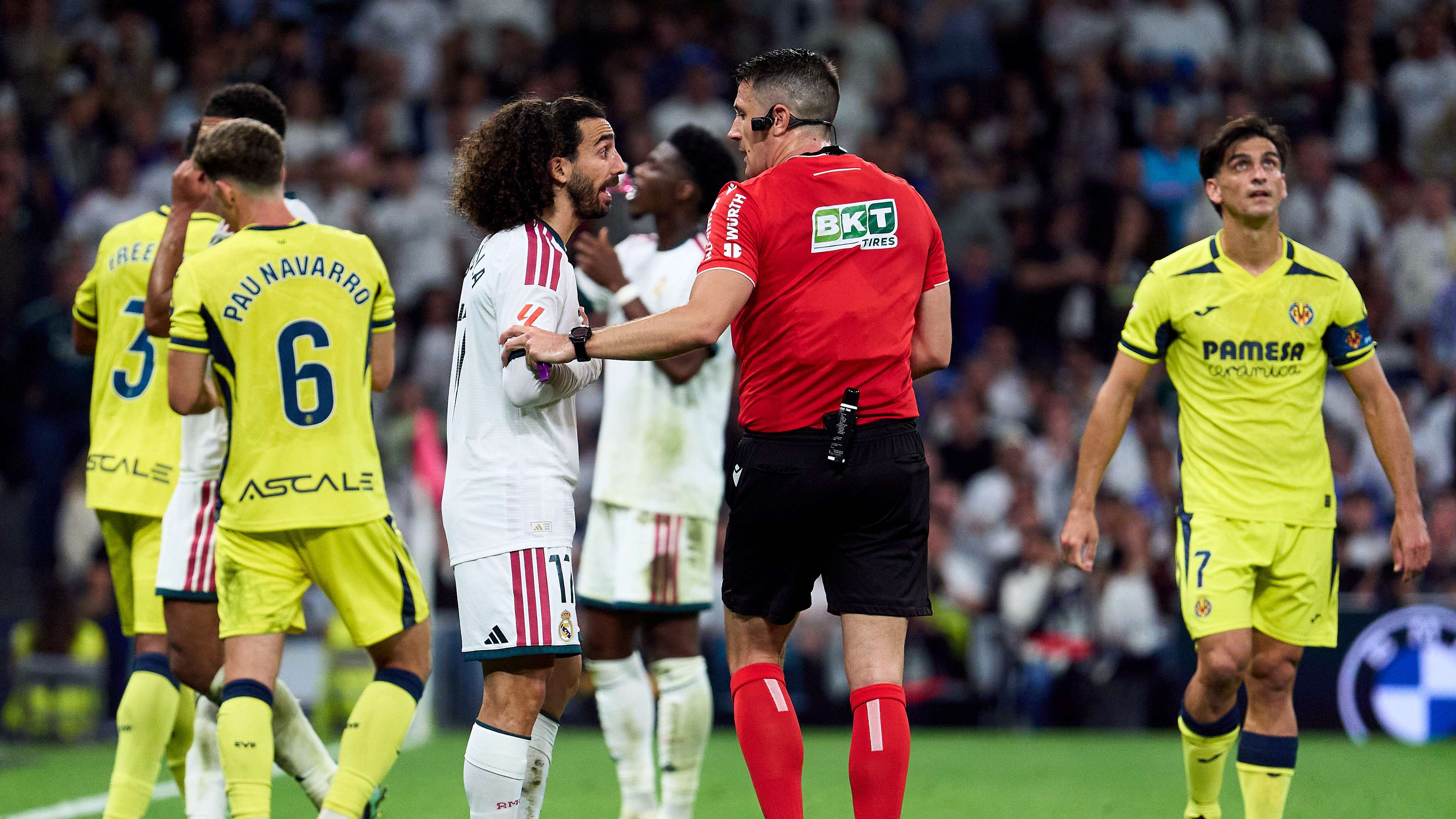
The tension was evident during Madrid’s hard-fought home victory over Villarreal. Rather than being remembered solely for the result, the game was overshadowed by disputes over officiating. Vinícius Júnior was sent off after pulling the hair of Villarreal defender Saliba, a flashpoint that drew attention to the referee’s decisions and the conduct of players on the pitch.
José Mourinho was also dissatisfied after the match and did not attend his post-game media duties, according to the original report. His absence added another layer to the fallout, ensuring that discussion continued after the final whistle. Such episodes can quickly become part of a broader narrative, especially when a major fixture is approaching.
Officials fear the Clásico buildup could worsen
Spanish radio station Cadena SER, through its programme El Larguero, has reported that refereeing circles are already anticipating a difficult lead-up to the Clásico. The expectation is that criticism and pressure will increase as the match gets closer, particularly if either club is involved in further controversial decisions before the meeting.
For match officials, the challenge is not simply to make accurate calls during a high-stakes game. They must also work in an environment where every decision may be examined from multiple angles and discussed by players, coaches, supporters and broadcasters. A disputed penalty, a red card or a marginal offside call can quickly dominate the football conversation and shape perceptions of the entire contest.
The technical committee is said to be uneasy about the full range of pressure surrounding Madrid matches. That includes the atmosphere inside stadiums, public criticism, media coverage and the views expressed by people connected to the club. Referees need to be able to officiate without feeling that every mistake will be treated as evidence of deliberate bias.
Perceptions of bias pose a wider challenge
One of the most serious concerns described in the reports is the belief among some at Real Madrid that referees are intentionally making decisions against the club. Whether or not that view is supported by evidence, the perception itself can deepen mistrust between teams and officials. Once suspicion takes hold, even routine decisions may be interpreted through the lens of past controversies.
This creates a difficult cycle for Spanish football. Strong criticism can put officials under greater pressure, while defensive responses from referees or governing bodies may be seen by critics as proof that the issue is not being addressed. The result is an increasingly tense environment in which discussion about the rules can overshadow the sport’s central attraction: the quality of the football.
That risk is amplified in a Clásico, a fixture watched around the world and followed by millions of supporters. Barcelona and Real Madrid bring different tactical approaches, elite players and long-standing rivalry to every meeting. The referee’s role is essential, but attention can shift away from the teams’ strategy and performance if controversy becomes the dominant storyline.
What to watch before the match
The two weeks before kick-off will be important. Any new dispute involving a referee could intensify the atmosphere, while public comments from club figures may influence how supporters approach the match. The officials’ technical committee will also be watching closely, given reports that it expects the situation to become more difficult rather than settle down.
For fans considering a football prediction, the broader context matters alongside league position and recent form. A tense buildup can affect the emotional temperature of a match, but it does not determine the result. Team selection, fitness, tactical discipline and the ability to stay composed under pressure are likely to be just as important as the headlines about refereeing.
Neither club can control every decision made on the pitch, but both can influence the tone around the fixture. Clear communication, respect for match officials and a focus on football could help prevent the buildup from becoming a contest about blame. That does not mean controversial calls should escape analysis; it means criticism should be grounded in evidence rather than assumptions about intent.
A high-stakes meeting under a cloud of scrutiny
With Barcelona reportedly holding a six-point advantage, the Clásico carries major implications for the La Liga standings. A home win could strengthen the leaders’ position, while a Madrid victory could tighten the race and shift momentum. A draw would leave both sides with plenty to play for, but the result may be accompanied by intense debate if any key decision proves contentious.
Refereeing officials are said to have no clear sense of when the current atmosphere will ease. For now, their concern is that the pressure surrounding Real Madrid’s matches will continue to grow as the Barcelona encounter approaches. The hope for Spanish football is that the spotlight falls primarily on the players, the tactics and the quality of the contest—not on a fresh dispute that overshadows the Clásico.