


How To Become a Professional Football Coach In India? India has often been described as a “sleeping giant” in terms of its football talent. The statement appears to be true on the surface since a nation with this size of population is bound to have more hidden talents than other nations. But when that sleeping giant will rise is still a mystery. And what actions need to be taken to make that possibility a reality?
India is a big nation with a lot of football talent, but much more work needs to be done to identify and nurture that skill into something more useful. In this case, a coach’s role is crucial. India has not had enough professional football coaches at the grassroots level to recognize talent and steer players in the right direction.
Schools have given physical education teachers the responsibility of planning football practices and selecting a team for far too long. Respectfully, physical education teachers are not equipped to instruct students in the subtleties of the game. Football is becoming more and more popular in India, and schools are realizing how important it is to have a qualified football coach.
They are currently searching for coaches to assist them in training children.
The All India Football Federation, which is in charge of overseeing football in India, is acting increasingly decisively as the tide has started to change. The objective is to produce qualified and certified football coaches across the nation.
Its various coaching diplomas and certification programs aim to educate and prepare football coaches in India in several areas, such as how to plan, organize, and carry out coaching sessions, how to identify talent quickly, and how to stay up to date with the latest advancements in football coaching.
To progress in their education and career as a football coach, prospective coaches must complete a rigorous certification process. The complete list of coaching courses that the AIFF offers is provided below.
How To Become a Professional Football Coach In India?
How to become a football coach in India – STEP 1: AIFF “E” License
The latest endeavor by the governing body, aimed at disseminating even more fundamental and grassroots coaching knowledge, is now regarded as an “introductory course.”
a four-day program for which applicants must be at least eighteen years old and apply through their state organization. Golden Baby League accreditation as a coach is made possible by the licensing standards.
How to become a football coach in India – STEP 2: AIFF “D” License
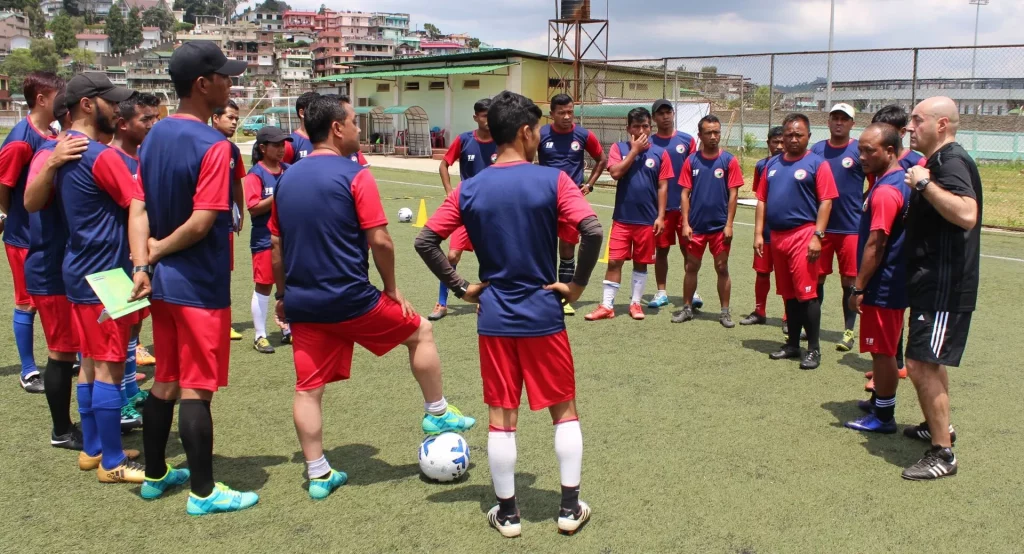
The “D” License, which was originally referred to as the “introductory course” in football coaching in India, is a six-day course designed to prepare gifted coaches for the “C” License, the next step up the ladder.
Coaches who fulfill the licensing requirements can work in any school, academy, or league that they are affiliated with. There is a theory test and two practical exams for the course. To be certified, one must pass each of the three exams.
How to become a football coach in India – STEP 3: AIFF “C” License
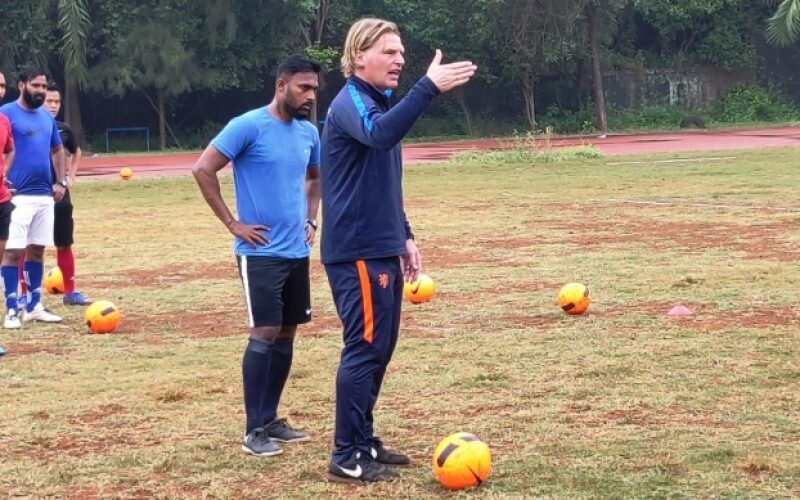
Training session planning, coordination, and administration are the topics covered in the next coaching certification level. There are two modules in the 12-day curriculum, each having three practical and two theoretical tests.
To apply for this license, candidates must have finished the “D” license and have worked as coaches for at least three months. Coaches of national junior and junior league teams, as well as school teams, may be employed if they fulfill the license requirements.
STEP 4: AFC “B” Diploma
Football coaches who have previously obtained their license may apply for the AFC “B” Diploma/Certificate in India, as the AIFF would proceed in compliance with the Asian Football Confederation (AFC). The main objective is to disseminate knowledge about playing styles and to create more team-building activities that incorporate tactical considerations.
There are three modules in the course, and finishing them all takes 19 days. Indian license standards must be fulfilled before a person can coach a team in the Junior National Football Championship, Elite, or National Second Division League.
STEP 5: AFC “A” Diploma
The goal of this program is to improve coaches’ management and talent-spotting abilities while imparting knowledge of the tactical and technical components of the game as well as physiological and psychological concepts.
The course is divided into three sections that are spread out over a full week. The necessary licenses enable the coaching of both state senior squads and I-League teams.
STEP 6: AFC Professional Diploma
The highest level of certification offered in India is the Pro License from the AFC, which aims to teach coaches the newest and most cutting-edge coaching methods needed to oversee clubs and national teams.
Though it is still undergoing review, the program is generally broken down into four stages. The license requirements may be used by coaches of senior national teams and professional football clubs.
STEP 7: AFC Goalkeeping Level (1,2 & 3)
Every professional club is assigned a goalkeeping coach. A goalkeeping-level certificate is necessary for those who wish to work in this industry.
The minimum requirement to apply for goalkeeping-level certificates is the AIFF “C” License.
STEP 8: AFC Conditioning Coaching License (1A, 1B, 2A, 2B)
The program, which is a component of the AFC’s specialized courses, attempts to enhance players’ overall conditioning and prepare them for the physical demands of the game. Professional teams are always in need of conditioning coaches to maintain their players’ performance levels and stay up to the physical demands of the game.
STEP 9: AFC Futsal Certificate Level (1,2,3)
Seeing as how quickly futsal is spreading throughout the world, the AIFF aims to teach football coaches how to play the game to find unique talents and establish a strong futsal foundation in the nation. Those who are interested in this field can learn Futsal-specific strategies and techniques from the several certification levels.
In summary, there are many opportunities for a football coach in India due to the lack of professional teams, especially at the local level. Early on in the process, talent identification and development must start. Thus, at the school and academy levels, qualified coaches are needed.
