
Hoeness Defends Neuer After Record-Breaking Bayern Blunder
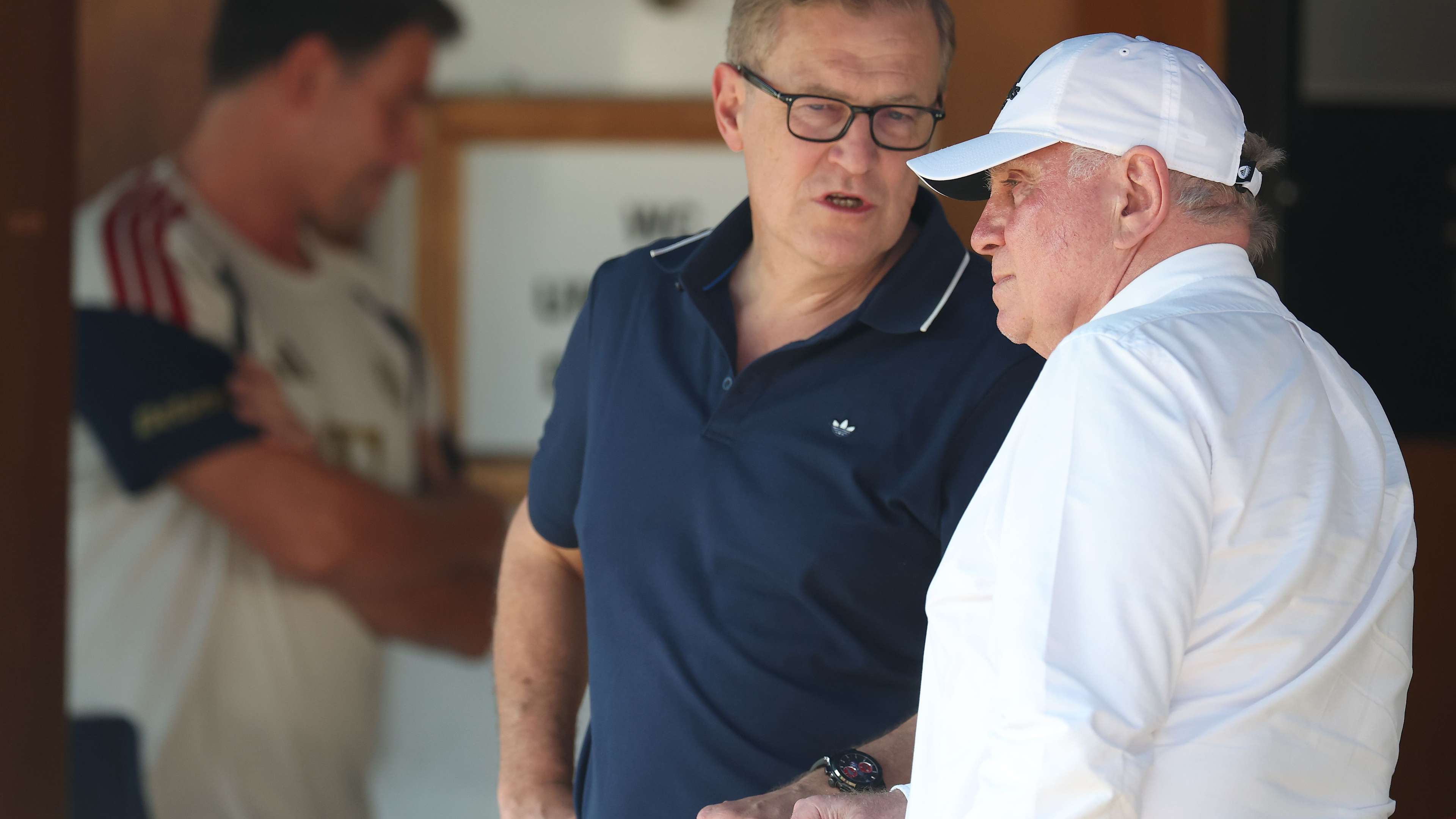
Bayern Munich honorary president Uli Hoeness has rejected suggestions that Manuel Neuer’s time at the top may be coming to an end, insisting that even an experienced goalkeeper is entitled to make mistakes. His comments followed a costly error in Bayern’s 2-2 Bundesliga draw with Augsburg, a match that began with one of the fastest goals in the competition’s history.
The result also reignited wider debate about Bayern’s early-season form, the demands placed on elite players, and the crowded international football calendar. Hoeness used the opportunity to criticise the timing of the latest international break and the expanded 48-team World Cup, arguing that clubs are left to manage the consequences when players return from national duty.
Neuer’s Error Gives Augsburg an Instant Lead
Neuer’s mistake came almost immediately after kick-off. The Bayern captain’s attempted pass went astray, allowing Augsburg forward Robin Fellhauer to seize possession and score. The goal arrived just eight seconds into the match, setting a new record for the fastest goal in Bundesliga history.
For a goalkeeper with Neuer’s reputation, the incident inevitably attracted attention. The German international has long been regarded as one of football’s most influential goalkeepers, celebrated not only for his shot-stopping but also for his ability to play far beyond his penalty area. That adventurous style can help Bayern build attacks, but it can also make errors more visible when a pass or decision goes wrong.
Despite the dramatic start, Bayern recovered to earn a 2-2 draw. The match nevertheless provided fresh material for questions about Neuer’s form and whether the club should begin preparing for a new first-choice goalkeeper. Hoeness dismissed that speculation, saying: “No, not at all. Anyone has the right to make a mistake from time to time.”
His response reflects a broader point about judging players over more than one moment. A single error can shape the headlines, especially when it produces a record-breaking goal, but it does not by itself settle questions about a player’s overall ability or place in the team. For Bayern, the more useful measure will be how Neuer responds in the matches that follow.
Hoeness Criticises International Football Scheduling
Neuer’s mistake was only one part of Hoeness’s comments. The Bayern figure also voiced frustration with the timing of the international break, which arrived only four weeks after the Bundesliga season began. He said 18 members of Bayern’s squad had travelled to represent their countries, leaving the club to readjust its training and match preparation around their absences.
“We suffer the most from the long World Cup,” Hoeness told German newspaper Bild, pointing to the late return of players before the domestic campaign began on 25 August. He described the two-week break so soon after the start of the season as a “disaster” for clubs trying to build rhythm and establish their strongest line-ups.
International breaks are part of the modern football calendar, giving national teams time to prepare for major tournaments and qualifying campaigns. But their placement can disrupt club routines, particularly for teams with large numbers of international players. Coaches may have limited time to work with their full squads, while players face travel, changes in training schedules and the possibility of returning with injuries or fatigue.
Hoeness argued that clubs have a legitimate reason to speak up because they pay players’ wages and depend on their availability across a long season. His criticism was especially pointed towards the UEFA Nations League, which he called “the joke of the year.” The competition was introduced to provide more meaningful international fixtures than friendlies, but its place in an already crowded schedule remains a source of debate among club officials and supporters.
World Cup Expansion Adds to Club Concerns
Hoeness also questioned the expansion of the FIFA World Cup to 48 teams. The larger tournament is designed to include more nations and create additional opportunities for international football, but it also means a longer competition and more matches for players whose clubs already face demanding schedules.
That concern is particularly relevant for leading European sides such as Bayern, whose players are regularly selected by national teams. A longer World Cup can affect the timing of pre-season preparations, recovery periods and the start of domestic campaigns. The challenge is not limited to one club: teams across Europe must balance the commercial and sporting value of international tournaments with the physical demands placed on their squads.
There is no simple solution. National associations want players available for important fixtures, while clubs need adequate time to train and compete in domestic and continental competitions. As football’s calendar continues to expand, disagreements over workload and scheduling are likely to remain a recurring issue.
Hoeness Pushes Back on Kimmich Debate
Hoeness also dismissed what he described as an excessive debate surrounding Joshua Kimmich. The Bayern midfielder has frequently been the subject of discussion about his role, leadership and standing in the German national team. Hoeness suggested that younger or newly promoted players should first establish themselves as regular starters at their clubs before being compared with established figures.
His remarks underline the pressure that comes with playing for Bayern and Germany. A player’s performance can be judged not only by his contribution on the pitch but also by expectations around leadership, consistency and tactical responsibility. Hoeness’s defence of both Neuer and Kimmich suggests he believes public criticism can move too quickly from a specific performance to sweeping conclusions about a player’s future.
What Bayern Supporters Should Watch Next
For Bayern, the immediate focus will be on restoring consistency after the draw with Augsburg. Supporters will want to see whether the team can sharpen its defensive organisation, avoid costly lapses and maintain control when opponents press aggressively. Neuer’s distribution will remain an important part of Bayern’s approach, making his response to the early error a key storyline in upcoming matches.
Any prediction about the goalkeeper’s long-term future should be based on a sustained run of performances rather than one high-profile mistake. Bayern’s results, Neuer’s fitness and the club’s plans for succession will all shape that discussion. Hoeness, at least for now, has made his position clear: he sees no reason to treat the Augsburg incident as proof that Neuer’s era is over.
The episode also highlights a wider tension in modern football. Clubs want continuity, availability and time to prepare; national teams and tournament organisers seek more fixtures and broader participation. As the calendar grows busier, the debate over player welfare and scheduling may prove just as significant as the result of any single match.