
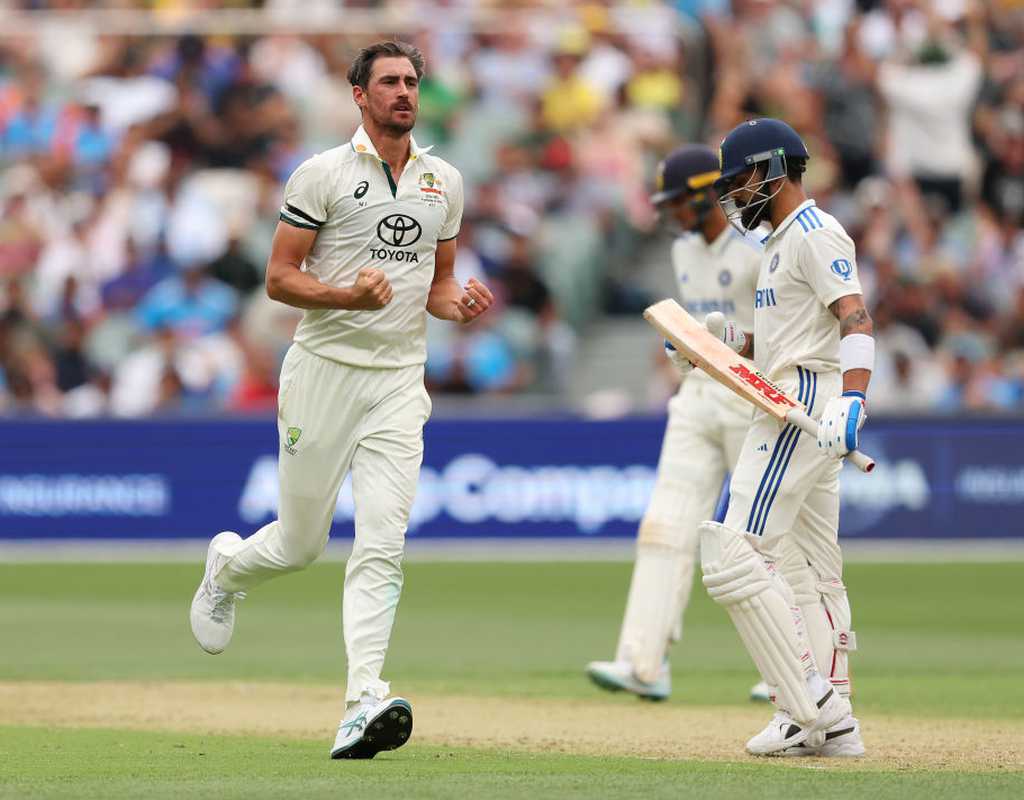

Australia’s Pacers Dominate First Session, India Struggles at 82/4
An action-packed first session of the much-anticipated cricket match between Australia and India saw Australia’s pacers ripping through India’s top order, leaving the visitors struggling at 82/4. Mitchell Starc set the tone upfront by taking out key batsmen Yashasvi Jaiswal, KL Rahul, and Virat Kohli.
Starc’s Early Strikes
With the very first ball of the match, Starc had Yashasvi Jaiswal, the centurion from the first Test, playing around a full delivery and getting him trapped LBW. This early breakthrough gave Australia the perfect start on their comeback trail after facing criticism in the previous match.
Although KL Rahul got a lucky reprieve when he was adjudged caught behind off Scott Boland’s first ball, it was discovered that the pacer had overstepped. Usman Khawaja also dropped Rahul at first slip in the same over, providing India with much-needed relief in the face of Australia’s strong bowling attack.
Gill and Rahul’s Stand
Despite the early setbacks, Shubman Gill and KL Rahul managed to stabilize India’s innings with a 69-run partnership. Gill, playing his first Test of the series, showcased his skills by capitalizing on Starc’s attacking lengths to score some impressive boundaries. Rahul, on the other hand, took his time to settle in before finding his rhythm.
However, Australia regained control in the final half-hour of the session, with Starc once again proving to be the chief tormentor. He dismissed Rahul and Virat Kohli in quick succession, swinging the momentum back in Australia’s favor. Scott Boland also got the better of Gill, trapping him leg before wicket with a well-executed delivery.
India Struggles at 82/4
With three quick wickets falling in the space of fifteen balls, India found themselves in a precarious position at 82/4 by the end of the session. Despite the initial resistance shown by Gill and Rahul, Australia’s pace battery proved to be too much for India’s top order to handle.
At the interval, India’s score stood at 82/4, with KL Rahul top-scoring with 37 runs while Mitchell Starc emerged as the pick of Australia’s bowlers with figures of 3-31.
As the match progresses, all eyes will be on India’s middle order to stage a comeback and put up a competitive total against Australia’s formidable bowling attack. Stay tuned for more updates as the action unfolds on the cricket field.
The Impact of Australia’s Pace Attack
Australia’s dominance in the first session can be attributed to their potent pace attack, led by Mitchell Starc. The left-arm fast bowler’s ability to swing the ball at high speeds troubled India’s top order batsmen, causing havoc early on in the match. Starc’s precision in exploiting the conditions and extracting movement off the pitch made him a constant threat throughout the session.
In addition to Starc, the supporting cast of Scott Boland and others added to India’s woes with disciplined bowling and well-placed deliveries. The relentless pressure exerted by Australia’s pacers forced the Indian batsmen to play defensively, resulting in wickets falling at regular intervals.
Resilience of India’s Batsmen
Despite the challenging conditions and the onslaught from Australia’s bowlers, Shubman Gill and KL Rahul displayed resilience in their partnership. Gill’s elegant stroke play and Rahul’s gritty determination helped India recover from the early setbacks and build a solid foundation. Their partnership showcased the depth of India’s batting lineup and the ability to counterattack in tough situations.
However, the quick succession of wickets towards the end of the session highlighted the fragility of India’s top order against quality pace bowling. The dismissals of Rahul, Gill, and Kohli exposed the vulnerability of India’s batting lineup under pressure, emphasizing the need for the middle order to step up and deliver in the upcoming sessions.
The Path Ahead for India
As India regroups during the interval, the focus will be on devising a strategy to counter Australia’s relentless pace attack and stabilize the innings. The middle order comprising of experienced batsmen like Cheteshwar Pujara and Ajinkya Rahane will play a crucial role in steering India towards a competitive total.
The onus will be on Rahane, Pujara, and the lower middle order to weather the storm created by Australia’s pacers and build partnerships to negate the early damage. The ability to absorb pressure, rotate the strike, and capitalize on loose deliveries will be key factors in India’s quest to stage a comeback in the match.
Conclusion
As the match progresses, the battle between Australia’s pace battery and India’s batting lineup will continue to unfold, providing fans with enthralling cricketing action. The ebb and flow of the game, the strategic maneuvers, and the individual performances will shape the outcome of this gripping contest between two cricketing powerhouses.
Stay tuned for further updates and analysis as the match resumes post-interval, with both teams vying for supremacy on the field. The stage is set for an exhilarating battle of skill, strategy, and resilience in this high-stakes cricket encounter.